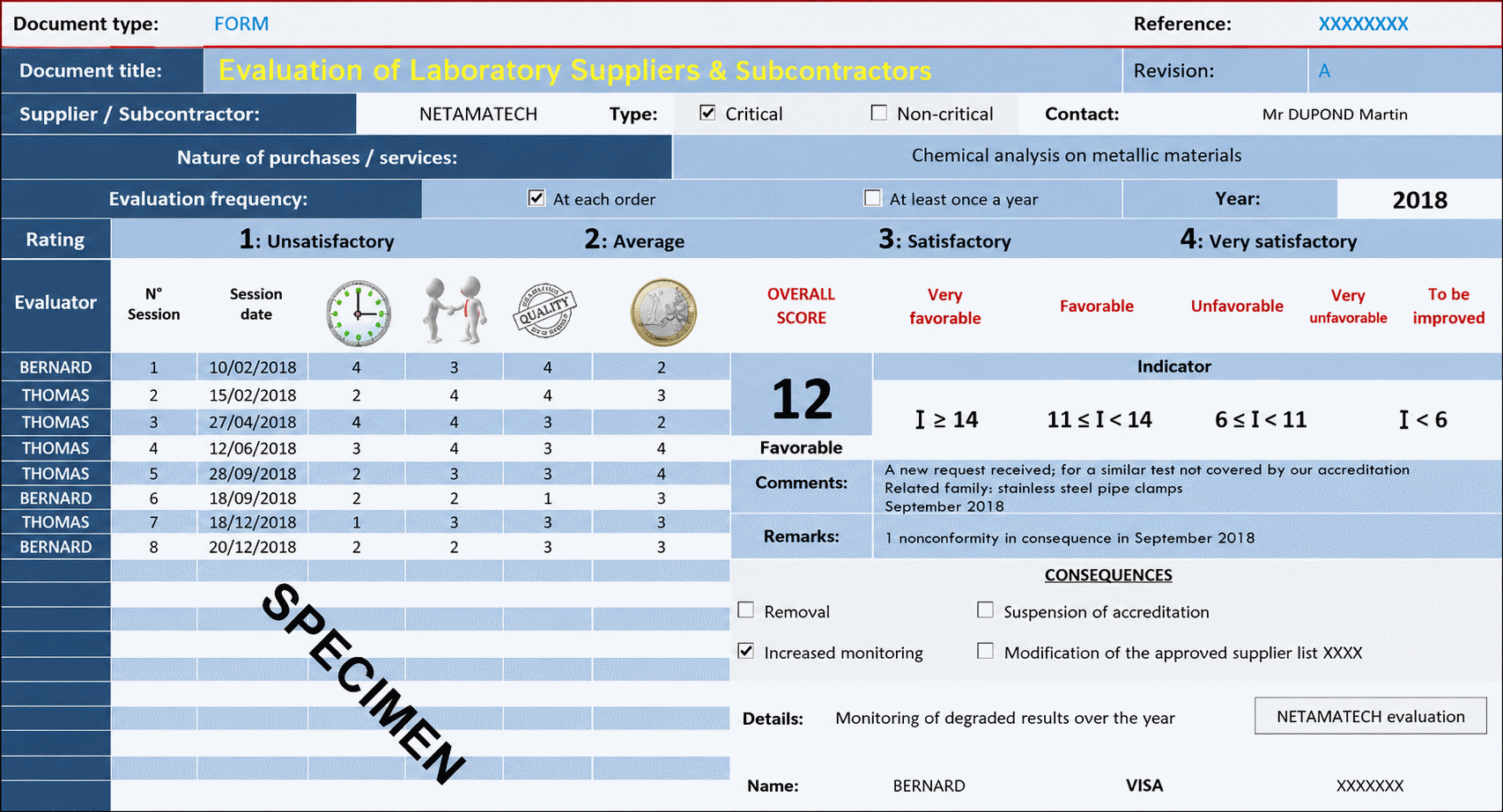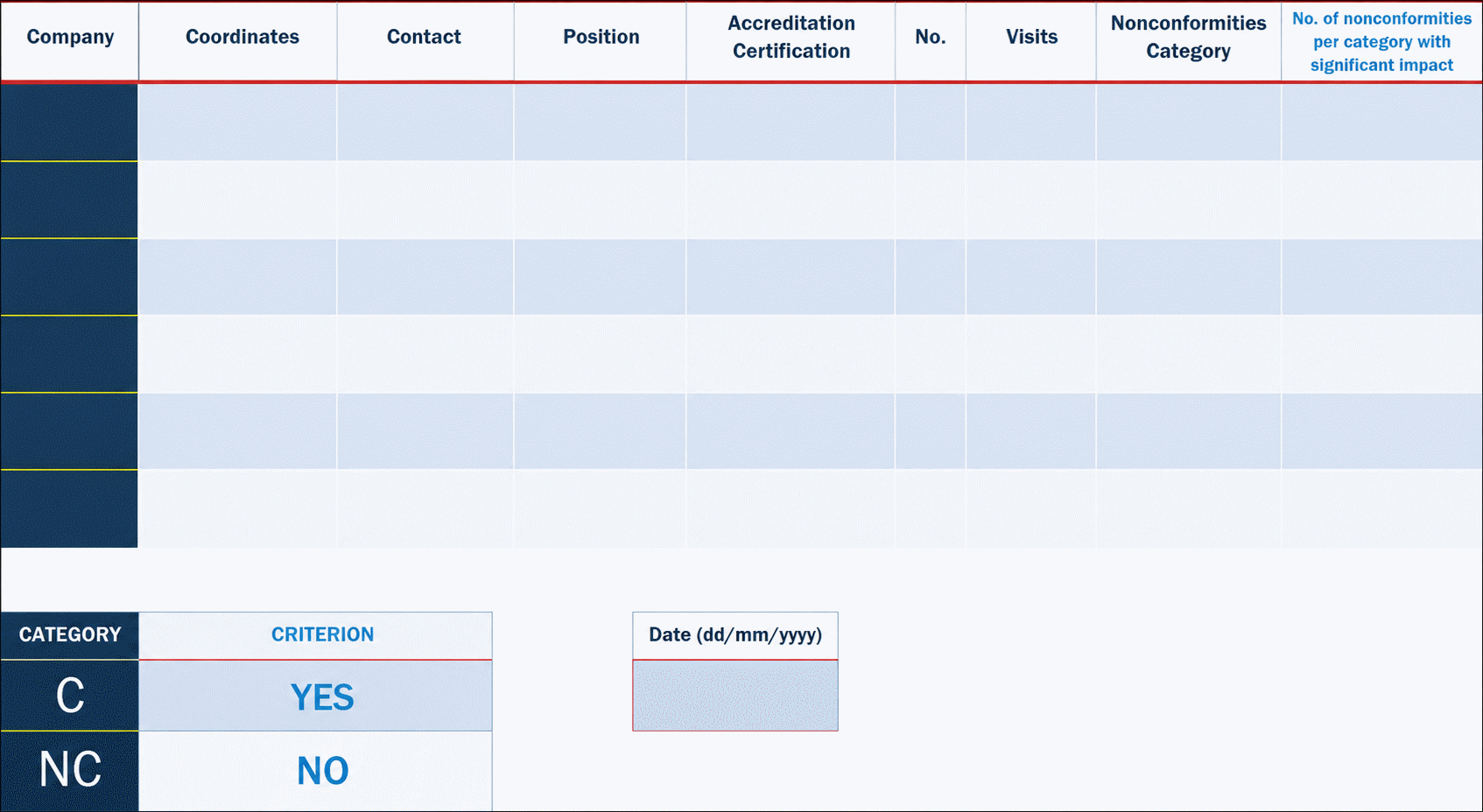
A stand-alone form can be used to address this requirement by consolidating the annual evaluation, the conclusion, and any resulting actions in a single document.
The digital tools provided to laboratories also help document the list of critical suppliers and monitor their quality certifications.
6.6 Externally provided products and services
6.6.1 The laboratory shall ensure the suitability of externally provided
products and services that affect laboratory activities when they are:
a) intended to be incorporated into the laboratory’s own activities;
b) provided, in whole or in part, directly to the customer by the laboratory,
as received from the external provider;
c) used to support the operation of the laboratory.
6.6.2 The laboratory shall have a procedure and retain records to:
a) define, review, and approve the laboratory’s requirements for
externally provided products and services;
b) define the criteria for the evaluation, selection, performance monitoring,
and re-evaluation of external providers;
c) ensure that externally provided products and services conform to
the requirements established by the laboratory or, where applicable,
to the relevant requirements of this International Standard, before
they are used or provided directly to the customer; and
d) take any actions resulting from the evaluations, performance monitoring,
and re-evaluations.
6.6.3 The laboratory shall communicate to external providers its requirements
regarding:
a) the products and services to be provided;
b) the acceptance criteria;
c) competence, including any required personnel qualifications;
d) the activities that the laboratory, or its customer, intends to perform
at the external provider’s facilities.

The laboratory shall have the necessary procedures for selecting and purchasing goods and services that have an impact on the quality of the services provided, including reagents and other consumables related to the activities performed.
These procedures shall cover not only purchasing, but also the delivery, storage, and preservation of purchased goods and materials, with particular attention to expiration dates, for example for liquid standards.
Purchases shall be made based on specific purchasing specifications. These specifications shall contain all necessary information and shall be reviewed and approved before being issued.
Conformity with the requirements defined in these specifications shall be verified through inspections, tests, checks, or other appropriate means, and this verification shall be documented.
The laboratory shall ensure that purchased goods and services are not used until these verifications have produced a positive result.
If the laboratory subcontracts tests for which it is accredited, for example due to insufficient machine capacity, it may report the results under its own accreditation and under its own responsibility. It does not require the report to indicate the name of the subcontractor that actually performed the service. However, this information may be useful to the customer or required by certain reference documents.
If the laboratory subcontracts accredited tests for which it is not itself accredited, for example analyses not performed within the laboratory, it may report the results in its own report under the subcontractor’s accreditation, specifying the subcontractor’s accreditation number and indicating that the results are under the subcontractor’s responsibility. It is recommended to mention the subcontractor’s name.
Even when the customer imposes the choice of subcontractor, the original laboratory remains responsible for the results and must ensure that the subcontracted activity is performed in accordance with ISO/IEC 17025 requirements. The laboratory must therefore implement effective monitoring and ensure traceability of subcontracted activities.
The laboratory is required to perform more in-depth evaluations of suppliers of goods and services that are critical to the quality of its own services, such as suppliers of equipment, standards, reference materials, and similar items. Records of these evaluations shall be maintained, and a list of “qualified” suppliers shall be established.
In general, two classes of subcontractors are defined: “critical” subcontractors, which have a significant and direct impact on the quality of the services provided, and “non-critical” subcontractors, which are important but do not have a direct cause-and-effect relationship with the result, for example a supplier of intermediate laboratory equipment such as Class A laboratory glassware.
Supplier certification to ISO 9001, or product or service certification, is an initial criterion to be considered when selecting preferred suppliers.
Suppliers that hold accreditation should be given priority for all “critical” services.
The supplier’s declaration of conformity is also a reference element to be taken into account.
Proficiency testing providers are also subject to this requirement. The laboratory must verify that they hold recognized accreditation to ISO/IEC 17043, for example from COFRAC, UKAS, A2LA, NVLAP, DAkkS, or another recognized accreditation body.
Suppliers of certified solutions must also be accredited to ISO/IEC 17034.
Purchase orders shall be formalized in such a way that there is no ambiguity in the expression of the requirement, even when the supplier’s quotation is very detailed. It is still possible to find cases where equipment checks have been performed and invoiced even though they were not requested by the customer, particularly when quotations include a very large number of checks.
The purchase order shall include the list of equipment concerned, their identification, the ranges to be verified, the number of verification points, particularly when additional points are requested beyond those required by the applicable verification or calibration standard, any restrictions, such as a machine not reaching a given measurement range, whether at the upper limit or due to insufficient accuracy at the lower limit, the list of applicable standards with their publication dates, the internal criteria used to declare conformity, which may differ between the verification standard used by the service provider and the test standard for certain parameters, any additional checks not covered by the usual standards and for which the service provider may not necessarily be accredited, and the explicit request for certificates or reports bearing the logo or accreditation mark of the accreditation body, for services performed under accreditation except for those duly identified in the quotation as not being accredited.
If the laboratory needs tests, verifications, or calibrations to be
performed by an external service provider in the presence of laboratory
personnel and a third party, such as an inspector, the laboratory shall
inform the service provider in advance of the service.
All “critical” suppliers shall be evaluated according to
internal criteria. An annual analysis of these evaluations shall be
performed, and actions shall be taken when these evaluations identify
dissatisfaction affecting the quality of the laboratory’s results,
such as delays, irrelevant responses, or a gradual deterioration in
service quality over time.
Supplier evaluations often performed by purchasing departments in large companies, as well as the objectives of these evaluations, do not necessarily correspond to the laboratory’s expectations. These evaluations often focus on cost, lead time, turnover achieved with the supplier, and weighted scoring based on several criteria, frequently with the aim of consolidating all services with a single provider. Care must be taken to avoid deterioration in the quality of the services provided.
Laboratories’ needs are much more pragmatic: effectiveness, responsiveness, cost, technical response to the requirement, quality of the service provided, and, where applicable, the proposal of an alternative solution.