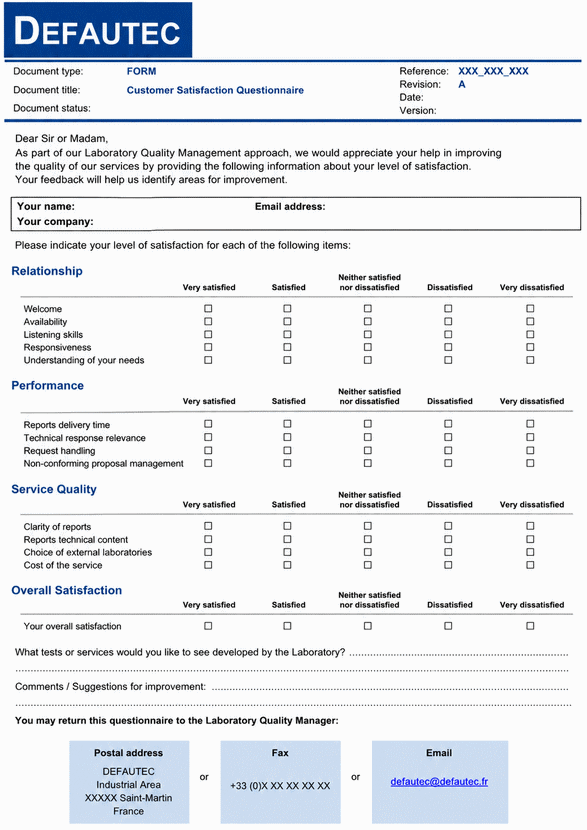
The customer satisfaction survey is one of the tools used to collect information from customers. Unfortunately, this information is often rather bland: everything is fine, but it does not provide any real opportunities for continuous improvement, especially since, in general, you should not expect more than a 10% response rate.
They are numerous and depend on the organization and the situation of the CAB. Everyone will need to improve their weaknesses across all departments of the organization and on all topics considered deficient or potentially at risk.
8.6 - Improvement
8.6.1 The laboratory shall identify and select opportunities for improvement
and undertake any necessary actions.
8.6.2 The laboratory shall seek feedback, both negative and positive,
from its customers. This feedback shall be analyzed and used to improve
the management system, laboratory activities, and customer service.

The improvement of the organization is often viewed in a limited way,
focusing mainly on meeting customer requirements and improving quality
objectives.
It consists of identifying the parameters or causes that affect the
achievement of objectives and making the useful and necessary changes
to correct them. These changes may take several months in order to verify
the effectiveness of the actions implemented.
Regarding customer satisfaction, the main challenge is to identify the
specific processes that have the greatest impact on customer satisfaction.
It should be remembered that satisfaction is relatively subjective,
as each customer has their own perception of the minimum level required
to meet their needs. This is even more true when some contacts are buyers
who do not have specific technical requirements; in such cases, cost
and lead time will usually be the main aspects considered when responding
to a satisfaction survey.
The CAB must determine and select opportunities for improvement:
• Improvement of services in order to meet the current and future
needs of customers;
• Corrective measures to respond effectively to problems encountered;
• Preventive actions to anticipate potential anomalies or underlying
trends;
• Actions to reduce undesirable effects: the system works, but it could
perform better;
• Improvement of QMS performance, such as selecting more relevant indicators
or reducing unnecessary complexity in the system;
• Improvement of the effectiveness of the quality management system.
Continual improvement is a “mandatory” approach for accredited and/or
certified laboratories, but it should also be natural and logically
embedded in day-to-day operations. However, it is sometimes difficult
to obtain actions that genuinely reflect continual improvement of the
laboratory’s quality system.
This is probably due to a lack of clarity among employees regarding
the meaning of these terms, daily operational pressure that leaves little
time to step back and ask questions — let alone find answers — and a
certain fatigue among personnel who are overwhelmed by all kinds of
constraints.
What does ISO/IEC 17025 offer to help us better understand all the possible
levers for continual improvement?
No fewer than nine clauses deal directly or indirectly with continual improvement:
7.7 — Ensuring the validity of test results
7.9 — Complaints
7.10 — Control of nonconforming work
7.11 — Control of data and information management
8.5 — Risks and opportunities
8.6 — Improvement and customer service
8.7 — Corrective actions
8.8 — Internal audits
8.9 — Management review
Let us first try to see how these different clauses interact with one
another:
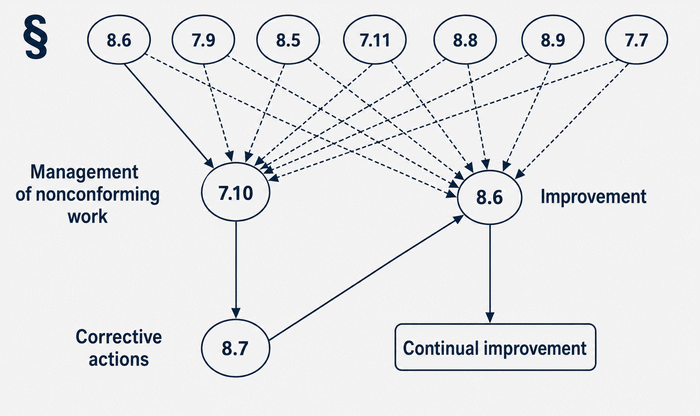
If we understand that potential nonconformities are simply the identification
of a possible failure to meet applicable requirements, it then becomes
much easier to determine the best action plan for handling them.
All personnel can participate more effectively in identifying risks
and opportunities because they are at the heart of the system.
This approach should be implemented formally, for example through a
suggestion box or a contest, to enable the laboratory to take a proactive
approach to continual improvement.
The standard does not provide any specific method for implementing continual
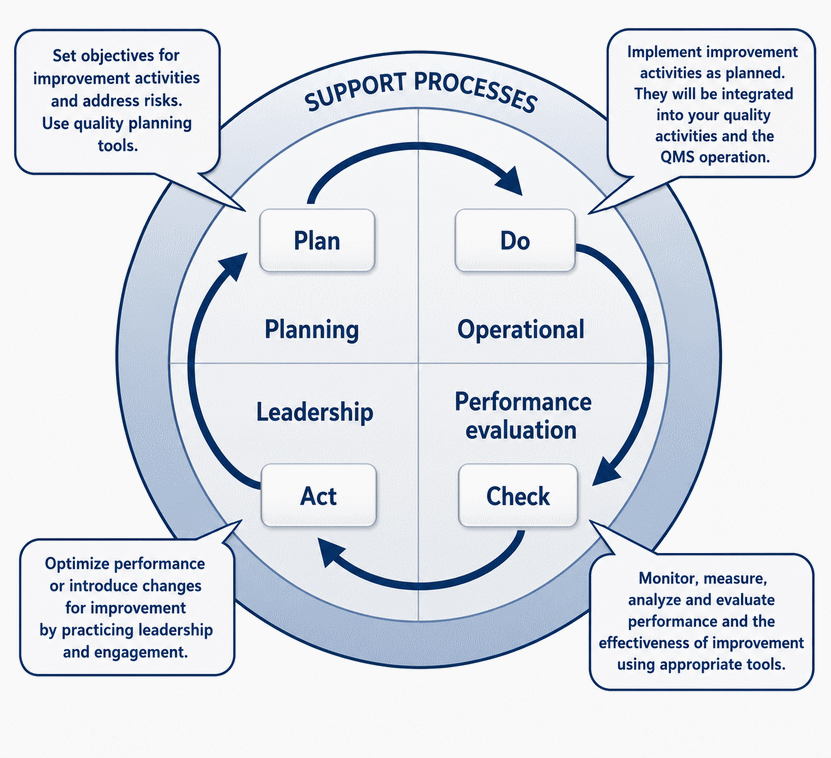
improvement, but it promotes the PDCA cycle approach: Plan-Do-Check-Act.
• The organization shall continually improve the suitability, adequacy,
and effectiveness of the quality management system.
• The organization shall review and evaluate the following types of
results:
• Results of the analysis of risks and opportunities, including the
selection of actions to address them or to achieve objectives, as well
as evaluations from internal and/or external audits;
• Results of customer satisfaction surveys;
• Results of the quality management review;
• Identification of processes or activities that may improve the performance
of the conformity assessment body and help determine the root causes
of nonconformities;
• Helping the organization understand how and where improvements should
be applied in order to achieve the greatest number of objectives.
The objective is to determine whether opportunities for improvement
exist, which can be considered as inputs for continual improvement.
1. Plan – The planning step begins when the CAB has identified an opportunity
for improvement for which it has all the necessary information and input
data.
During this planning stage, the CAB may ask the following questions
using the 5W2H method:
• Why is the improvement necessary?
• Which quality or process objectives were not achieved, or what problem
occurred?
• What needs to be done? Define the activities needed to achieve the
improvement and break down the improvement goal into achievable activities
using the **SMART** method.
Define the objectives, goals, and targets you want to achieve.
• Where should this be done? Define the scope, areas, processes, and
process outputs where improvement is expected.
• Who should do it and how should it be done? Define the resources and
responsibilities needed to achieve the expected results.
• When should it be done? Define a timeframe within which the improvement
can realistically be achieved.
Consider planning the action or actions with the participants and/or
process owners involved.
2. Do / Implement – This step refers to carrying out your plan.
Implement the plan, through the relevant participants, in the areas
or scope concerned within the organization.
The results of the “Do” phase will be incorporated into your activities
for the operation of the QMS and the delivery of services.
3. Check – Evaluate the effectiveness of the plan’s implementation.
You will monitor and measure the activities you planned and assess their
progress against the objectives of the plan.
This part is important: for each objective defined during the “Plan”
step, you must evaluate the results using indicators.
This step makes it possible to verify that the activities were carried
out as planned and to confirm that their results meet the defined objectives.
Depending on the results and conclusions of this step, you will move
on to the next step: “Act.”
4. Act – Improve the performance of your plan.
If your indicators show that the objectives and expected results of
the plan have not been achieved, review your plan and take action to
improve it.
Examine which parameters prevented you from achieving the objectives
and try again, or try a different approach.
Maintaining continual improvement requires leadership and top management
commitment, including taking responsibility for the effectiveness of
the QMS and establishing a dynamic policy to lead and support personnel
in contributing to the effectiveness of the QMS.