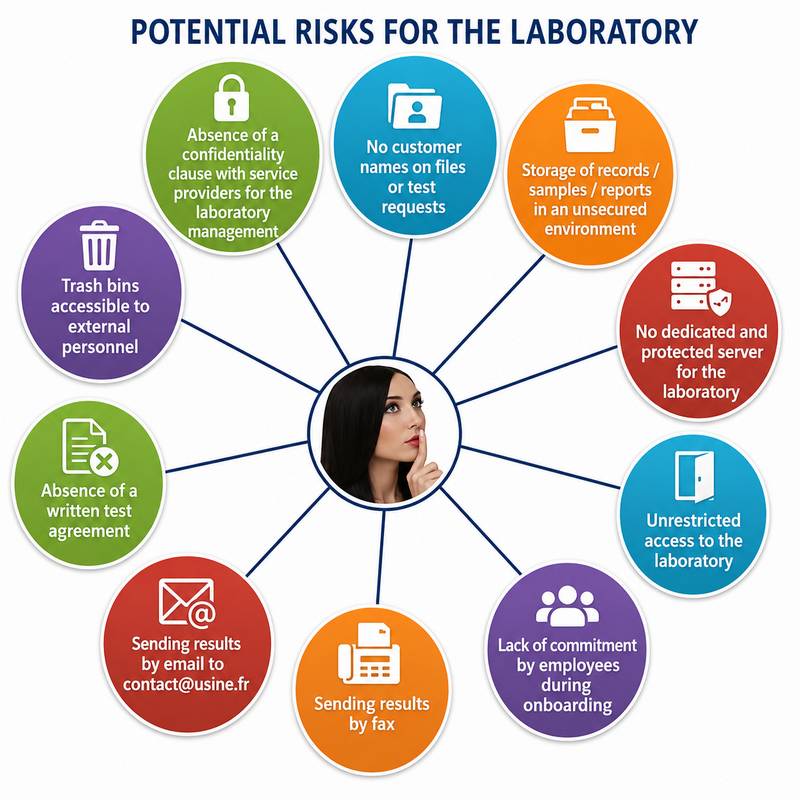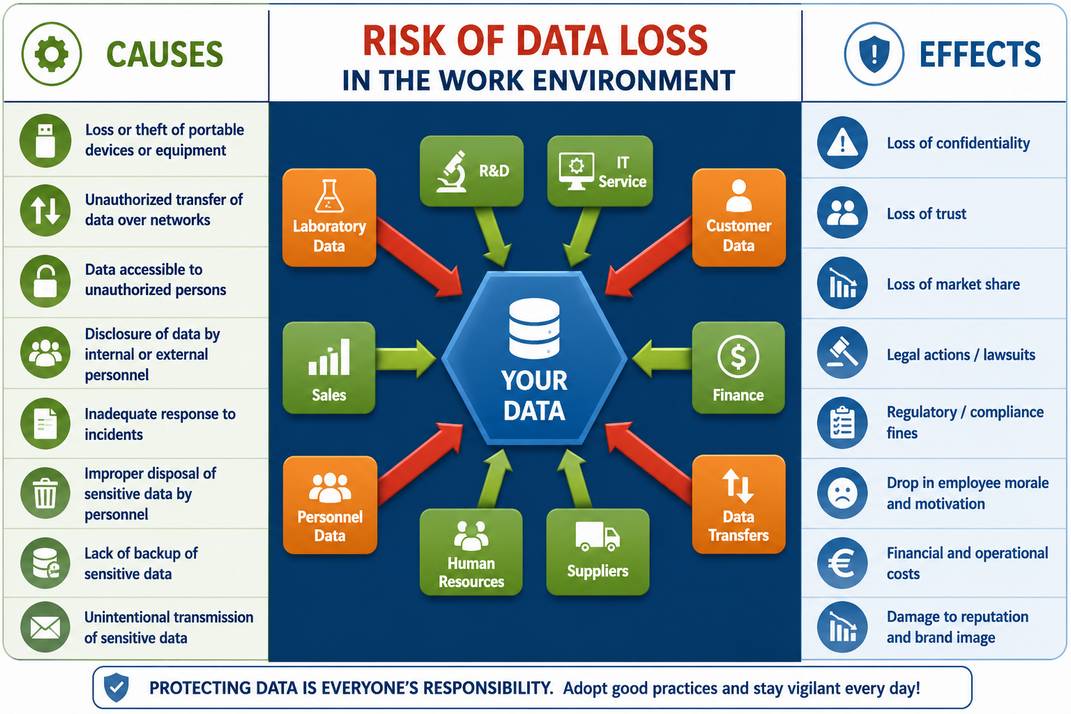
The causes of confidentiality breaches are numerous; they can be direct or insidious.
A loss of data related to a breach of confidentiality can have very significant impacts on an organization, whether accredited or not, with direct and indirect costs that are difficult to quantify in order to restore normal operations.
4.2 - Confidentiality
4.2.1 The laboratory shall ensure the protection of its customers’ confidential information and proprietary rights, including the electronic transmission and storage of results.
4.2.2 Through legally enforceable agreements, the laboratory shall be responsible for the management of all information obtained or generated during the performance of laboratory activities. The laboratory shall inform the customer in advance of the information it intends to make publicly available. Except for information made publicly available by the customer, or when agreed between the laboratory and the customer, for example for the purpose of responding to complaints, all other information shall be considered proprietary and shall be treated as confidential.
4.2.3 When the laboratory is required by law, or authorized by contractual arrangements, to disclose confidential information, the customer or individual concerned shall, unless prohibited by law, be notified of the information provided.
4.2.4 Information about the customer obtained from sources other than the customer, for example a complainant or regulatory authorities, shall be kept confidential between the customer and the laboratory. The laboratory shall preserve the confidentiality of the source of this information, and the source’s identity shall not be disclosed to the customer unless agreed by the source.
4.2.5 Personnel, including any committee members, contractors, personnel of external bodies, or individuals acting on behalf of the laboratory, shall keep confidential all information obtained or generated during the performance of laboratory activities.

This requirement has been strengthened, particularly in communications
with the customer when analyses or tests may be used and/or requested
by third parties, such as for regulatory compliance, product conformity,
counterfeiting issues, etc.
The confidentiality of laboratory results must be maintained at all times.
The Laboratory has a confidentiality policy that complies with the guidelines set out in management’s commitment.
The policy includes the following safeguards to ensure the confidentiality of information provided by customers or related to test results:
Laboratory personnel may not disclose any information regarding data obtained without the prior consent of the customer, except in the event of a request from a regulatory authority.
The CAB must inform customers of the data it intends to make public, and this must be done before any work begins.
Customers have the right to expect that information they provide on a confidential basis will be recorded and retained with the same level of rigor, kept in confidence, used for their benefit, and not disclosed or released without their authorization. Reports and certificates may not be transmitted to third parties unless the customer has been informed of what is to be disclosed and has freely given consent, without coercion.
The quotation must mention any potential disclosure of results or data, even partial data. The CAB’s decision or the customer’s choice must then be reconfirmed during the contract review.
Example: No data will be disclosed to third parties not involved in this service.
The requester, whether the customer or an organization representing a regulatory authority, must be properly identified by name, telephone number, and organization, and must provide evidence proving their affiliation with the organization and the legal legitimacy of their request.
Data provided by third parties other than the customer, but related to the customer, must be kept confidential and must not be disclosed to the customer, except with the third party’s consent.
Results may be sent by fax or email, provided that an evidentiary agreement has been established between the requester and the organization holding the results.
All employees, interns, and external auditors sign a confidentiality agreement when they take up their duties, through a dedicated form, job description, service contract, or equivalent document.
Sensitive results are physically stored in protected areas and digitally stored on secure servers with controlled access rights.
Customer reports are sent by postal mail in properly sealed envelopes suitable for the content.
Customer information is not left unattended on printers, desks, or similar locations.
Computer screens are protected by screensaver and timeout features,
as well as access rights.
Computer technology based on online access and the broader use of software programs has placed computer applications and other data-processing functions directly in the hands of users.
This improvement in efficiency presents a serious challenge in ensuring adequate data security.
Advances in information technology have not always been accompanied by an increase in users’ awareness of the vulnerability of data and information to threats such as unauthorized, deliberate or accidental modification, disclosure, and destruction of data.
All users must be aware of possible attacks aimed at compromising the integrity of a computer system, and must understand that reliable use depends on the integrity of that system.
Personnel must be made aware of certain poor practices that can degrade, corrupt, or infect data and information in general. The OEC will propose practical solutions to reduce exposure to the various threats.
Data and information protection implies an information system that is everyone’s responsibility.
All stakeholders, including information system users, each have a personal role to play in protecting data.
The OEC network administrator, namely the IT department, must provide appropriate security controls to protect the information resources entrusted to them.
They must raise staff awareness of the criticality of data and the extent of the losses that could occur if such data is not protected.
The IT department must ensure that all data and system users are familiar with the practices and procedures used to protect data.
The level of protection applied is based on the value of the information, meaning a risk analysis of the severity of the consequences if a certain type of information were accidentally modified, disclosed, or destroyed, as well as the need to make it readily available to users.
The complete system backup must be performed periodically, with the frequency determined by how quickly the information changes or by the volume of data.
Disk backups and server backups must be stored in a separate location so that the original data and the backup are not both lost in the event of an IT issue.
The installation of unauthorized hardware or free software that may contain malware can damage the data.