5.1 The laboratory shall be a legal entity, or a clearly defined part of a legal entity, that is legally responsible for all of its activities.
The laboratory, or the organization of which it is a part, shall be an entity that can be held legally responsible:
The quality of the services provided by the laboratory cannot be separated from a legal reference entity that assumes legal responsibility for the products and services provided. All other forms of responsibility and authority that influence the operation of the structure revolve around this legal responsibility.
Consequently, the laboratory, or the organization of which it is a part in the case of so-called “internal laboratories,” shall have its own legal identity.
This requirement is far from insignificant in the context under consideration and, as such, must rightly be defined as a “primary” organizational and management requirement.
The following shall be specified: the legal status, the name of the laboratory or department if the laboratory is part of a larger structure, and, where appropriate, reference may also be made to the entity’s process when the laboratory operates as a support process within the structure.
The “laboratory process” actually includes all tasks performed by
the laboratory:
- from taking the request into account,
- receiving the item to be tested, such as an instrument to be calibrated
or a sample to be analyzed,
- preparing it physically, through conditioning, and administratively,
through identification, test file creation, etc.,
- carrying out the measurement itself, whether testing or calibration,
- processing the results, including treatment, interpretation, etc.,
- drafting a test report, certificate, or equivalent document,
through to sending this report to the customer.
For example, for a testing laboratory within a larger company, production and sales responsibilities must be separate from laboratory management responsibilities.
Similar considerations also apply to a calibration laboratory within a company that manufactures and/or markets measuring instruments.
5.2 - Management5.2 The laboratory shall identify the management personnel with overall responsibility for the laboratory.
The roles responsible for supervision within the laboratory must be defined, and key functions must be clearly identified.
The standard no longer strictly requires the appointment of a Quality Manager. However, it does require personnel who have the authority and resources needed to implement, maintain, and improve the management system.
Substitution or back-up arrangements for these positions are not a requirement of the standard.
5.3 - Performance of activities
5.3 The laboratory shall define and document the range of laboratory activities for which it conforms to this document. The laboratory may only claim conformity with this document for this range of laboratory activities, which excludes laboratory activities provided externally on an ongoing basis.
The laboratory is responsible for carrying out its testing and calibration activities in such a way as to meet the requirements of this International Standard, as well as the needs of customers, regulatory authorities, and organizations providing recognition.
The organization and operation of the laboratory shall make it possible
to ensure:
- Compliance with applicable requirements;
- Satisfaction of customer needs;
Compliance with the requirements of regulatory authorities and recognition
bodies;
for all activities performed by the laboratory, whether they are carried out at a fixed or mobile facility, or directly “in the field.”
These requirements may be used to define part of the quality policy
objectives of the company or the laboratory.
The purpose of tests performed by the laboratory is to meet the internal
needs of the laboratory and/or the company, as well as external customer
requests, according to their specifications and/or applicable standards,
in order to validate the quality of the analyses or inspections performed.
These analyses may be carried out on ordered or manufactured products
within the scope of a third-party or in-house laboratory.
These tests are performed in compliance with the requirements of ISO/IEC 17025, which may be associated with specific technical or professional requirements. Such requirements must not be underestimated.
For example, within the scope of accreditation for toy testing, examinations are very often subject to interpretation. Participation in a standardization committee is therefore mandatory in order to discuss and adopt a common position among all laboratories. This requirement is not mentioned in ISO/IEC 17025.
The management system shall cover activities carried out at the laboratory’s permanent facilities, at sites remote from its permanent facilities, or in associated temporary or mobile facilities.
The management system of a laboratory wishing to perform analyses,
tests, or calibrations on site, or in mobile or temporary facilities,
shall include, among other things:
- An up-to-date list of mobile or temporary laboratories, for example
for the verification of testing machines on site;
- An up-to-date list of equipment used for on-site work, together with
the documentation associated with its use. Each instrument shall be
identified and monitored, and transport, storage, and preservation procedures
shall be defined;
- An up-to-date list of documents applicable to operators working on
site, including current instructions, document distribution rules, and
the withdrawal of obsolete documents. This is particularly important
when personnel working on site are not often present at the organization’s
headquarters;
- An up-to-date list of personnel specifically qualified to perform
analyses, tests, or calibrations on site, including monitoring of personnel,
authorization, and experience;
Procedures to ensure the control of records and reports associated with results obtained on site or in a mobile or temporary laboratory, including protected forms, defined procedures, and established presentation rules;
For calibration laboratories, an up-to-date list of the best on-site calibration capabilities and the limiting conditions for intervention.
This requirement is more difficult to implement for organizations whose activities are always, or partly, performed outside their own facilities.
Metrological traceability and the validity of the traceable connection are essential, especially when several operators are involved in the use of the equipment.
The organization must provide evidence that the equipment remains “capable” of meeting the applicable requirements. These requirements are not necessarily standard-based or regulatory; they may have been defined by the organization itself, taking into account the fact that the external environment may have a significant influence and cannot be controlled by the operator on the day of the intervention.
The estimation of measurement uncertainty shall take these parameters into account.
Example: 104°F during the inspection of a tensile testing machine in summer in a forge. Standard requirement: +59°F to +95°F.
5.4 - Scope of Laboratory Activities
5.4 Laboratory activities shall be carried out in such a way as to meet the requirements of this document, the laboratory’s customers, regulatory authorities, and organizations providing recognition. This includes laboratory activities performed in all of its permanent facilities, at locations away from its permanent facilities, in associated temporary or mobile facilities, or at a customer’s facility.
Activities performed in compliance with the requirements of this International Standard — meaning activities carried out under accreditation — must be clearly identified within the organization.
The accreditation scope of the conformity assessment body may normally be sufficient. However, the simplification of accreditation scopes may no longer make it possible to determine whether the laboratory is competent for specific standards, since the designation will become more generic, for example: Mechanical tensile testing or Analysis of metallic products.
It is therefore the responsibility of the conformity assessment body to maintain an up-to-date list of the standards for which it has demonstrated competence. This list should be kept up to date on the website of the notified body.
I recommend creating a specification or a form, particularly when changes occur regularly. This document could be entitled: List of tests performed by the laboratory. It would reproduce the designations used in the former accreditation scopes and would specify which tests are performed under accreditation and which are not.
This list should be updated whenever a new customer request is received, provided that the new standards do not require additional competence. The document may also be used as part of the laboratory’s risk and opportunity management process.
| ACCREDITED TESTING | ||||
| Items submitted for testing | Type of test | Measured parameters | Normative Reference for Methods | Resources and measures implemented |
Bars, steel parts, sheets, and strips |
Room-Temperature Tensile Testing |
Rm, Rp0,2, A% et Z% |
ISO 6892-1 ASTM E8/EM ASTM E370 EN 2002-001 ISO 16042 |
Tensile machine 600 kN |
| NON-ACCREDITED TESTS | ||||
| Steel tubing | Room-Temperature Tensile Testing | Surface defects | ISO 8496 | Tensile machine 600 kN |
The CAB shall document its procedures to the extent necessary to ensure the consistent application of its activities and the validity of the results. This requirement should be considered in connection with clause 7.7: Ensuring the validity of results.
Activities performed at customer facilities include all services that must be carried out on the customer’s premises and on the customer’s equipment, such as verification of testing machines, mapping of ovens or environmental chambers, on-site metrology, etc.
5.5 - Organization and Responsibilities5.5 The laboratory shall:
a) define the organization and management structure of the laboratory,
its place within any parent organization, and the relationships between
management, technical operations, and support services;
b) specify the responsibilities, authority, and interrelationships of
all personnel who manage, perform, or verify work affecting the results
of laboratory activities;
c) document its procedures to the extent necessary to ensure the consistent
application of its laboratory activities and the validity of the results.
The laboratory shall:
Define the organizational structure of the entity, the activities of
the Conformity Assessment Body (CAB), the laboratory’s position within
the organization, for example within an industrial group, administrative
information, functions, responsibilities, roles, hierarchical organization,
and functional relationships between the various departments and management.
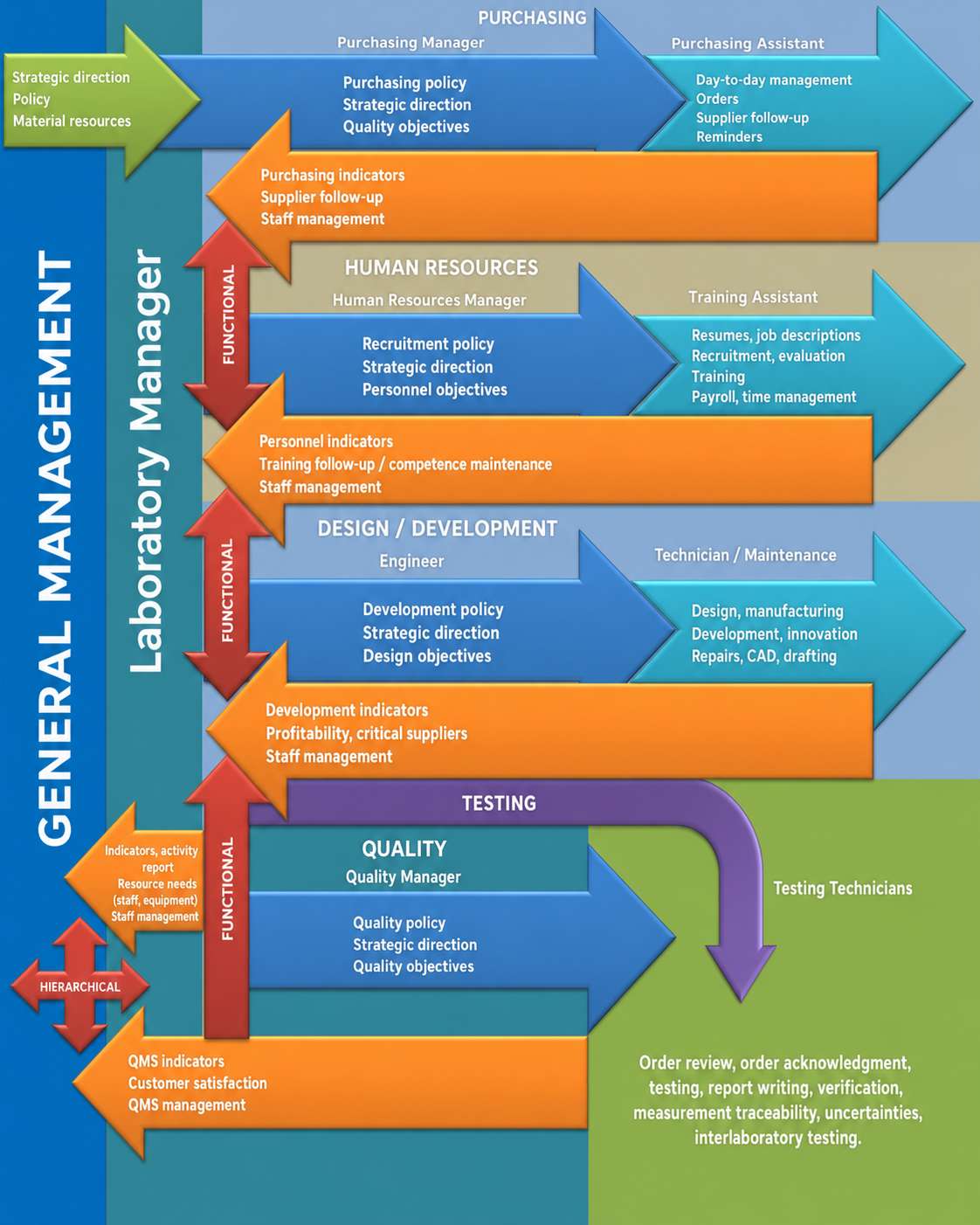
A named and functional organization chart is always necessary. I also recommend creating a table listing all individuals involved in the laboratory environment in order to clearly define their functions and tasks.
5.6 - Quality Management
5.6 The laboratory shall have personnel who, irrespective of other
responsibilities, have the authority and resources needed to carry out
their duties, including:
a) implementation, maintenance, and improvement of the management system;
b) identification of deviations from the management system or from the
procedures for performing laboratory activities;
c) initiation of actions to prevent or minimize such deviations;
d) reporting to laboratory management on the performance of the management
system and any need for improvement; and
e) ensuring the required validity of laboratory activities.
Have personnel with the authority, competence, and resources needed to ensure the implementation, monitoring, and continual improvement of the QMS, as well as the identification of any potential deviations, the implementation of actions, and the assessment of the effectiveness of QMS performance through feedback and reporting.
In other words, the CAB may retain its Quality Manager even if this person is not formally appointed as such.
The laboratory personnel’s daily activities must incorporate the elements of the quality system in the same way as their operational activities.
Within the laboratory, there is not the management system manager on one side and the rest of the personnel in charge of testing and/or calibration activities on the other: “quality is everyone’s responsibility.”
For a “shared” Quality Manager, a confidentiality agreement must be signed. The same applies to interns involved in strategic activities and to the external company that regularly cleans your premises.
5.7 - Backup and Communication Arrangements
5.The laboratory management shall ensure that:
a) communication regarding the effectiveness of the management system
and the importance of meeting customer requirements and other requirements
is implemented;
b) the integrity of the management system is maintained when changes
to the management system are implemented.
The QMS must be able to ensure continuity of service, regardless of any changes that may occur. The standard no longer requires deputies to be appointed for key positions; this approach should be considered in connection with clause 8.5, Actions to address risks and opportunities.
The laboratory must conduct information and awareness sessions and ensure that personnel are aware of the importance of their activities in relation to the objectives of the management system and customer satisfaction, including providing consistent responses to expectations.