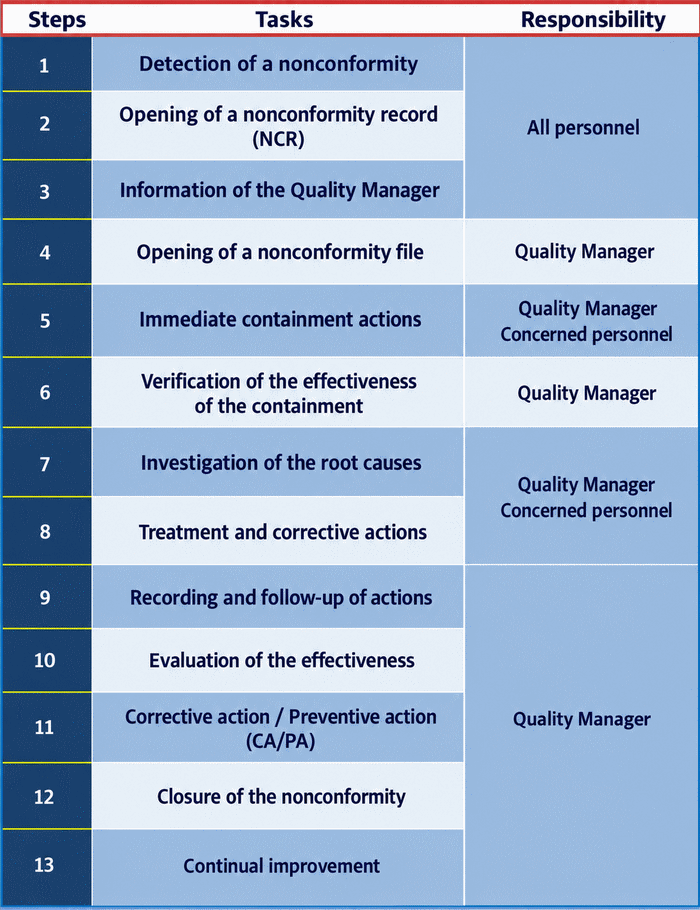
A process that does not tolerate poorly defined procedures, inadequately monitored actions, or ineffective customer relations.
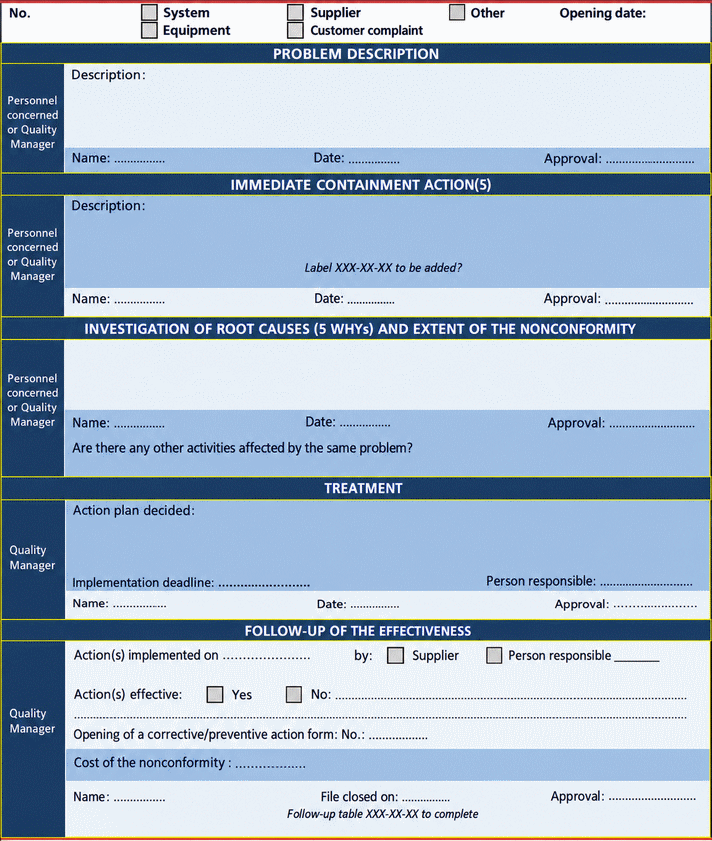
A nonconformity report, whether in paper form or electronic format within dedicated software, is mandatory to document and record day-to-day nonconformities that have a significant impact on the Quality Management System (QMS)..
7.10 - Nonconformity Management Process
7.10.1 The laboratory shall have a procedure that shall be implemented when any aspect of its activities, or the results of these activities, does not conform to its own procedures or the agreed requirements of the customer (e.g., when equipment or environmental conditions are outside specified limits, or when the monitoring of results fails to meet specified criteria).
The procedure shall ensure that:
a) The responsibilities and authorities for the management of nonconforming
work are defined;
b) Required actions (including stopping or resuming work and withholding
reports, as necessary) are based on the risk levels established by the
laboratory;
c) An evaluation is made of the significance of the nonconforming work,
including an impact analysis on previous results;
d) A decision is made regarding the acceptability of the nonconforming
work;
e) Where necessary, the customer is notified and work is recalled;
f) The responsibility for authorizing the resumption of work is defined.
7.10.2 Records shall be retained of nonconforming work and the actions
required as specified in b) through f).
7.10.3 Where the evaluation indicates that the nonconforming work could recur, or that there is doubt about the conformity of the laboratory's operations with its own management system, the laboratory shall implement corrective action.

Definition: A deviation of a quality characteristic from its intended level or condition, of sufficient severity to cause an associated product or service to fail to meet a specified requirement.
Examples of Nonconformities:
Customer complaints, unacceptable quality control results, equipment
failures, failure to follow instructions, purchases from unapproved
suppliers, subcontracted services that do not meet requirements, lost
samples, etc.
Any issue affecting quality must be documented, analyzed, and used as
an opportunity to improve weaknesses in the Quality Management System
(QMS).
Laboratories must have a form for recording nonconformities and anomalies related to their activities, i.e., situations in which the quality of their services or the effectiveness of their management system is called into question.
The form may be used in various situations, including customer complaints and findings resulting from internal audits, external customer audits, or third-party audits.
Some organizations also use electronic nonconformity reports. Dedicated software allows them to document findings, identify the individuals involved, and assign responsibilities. The software also maintains an audit trail and sends reminders to responsible personnel when required information has not been entered into the system.
When nonconforming work is detected, the work must be stopped and management must be informed. The root causes must be investigated, and a nonconformity report must be prepared.
The Quality Manager must determine the actions to be implemented. These include immediate actions, referred to as corrections, to resolve the problem as quickly as possible, where feasible, and longer-term corrective actions aimed at addressing the root causes and preventing recurrence.
Such actions may involve revising work instructions, clarifying information required on forms, or changing the policies of the Conformity Assessment Body (CAB).
For example, the CAB may establish a policy prohibiting work from being performed without a formal purchase order, even if the customer has verbally confirmed their intention to place an order.
When a nonconformity is detected, laboratory data must be retained and must not be released until the issue has been resolved and the laboratory management has verified that the necessary actions have been implemented in accordance with the corrective action process.
The resumption of work must be based on the risk levels established by the laboratory and may take place only after the required corrective measures have been implemented and approved.
The concept of risk in this context should not be directly associated with risks and opportunities. Rather, it refers to an immediate risk assessment, involving the questions that must be addressed at the time of the incident to determine whether services or processes should continue, considering the impact of the problem and its potential consequences for the Quality Management System (QMS) or customers.
However, indirectly, if the issue encountered had not previously been identified as a weakness or threat, the laboratory should update its risk and opportunity assessment to make it more comprehensive and conduct a more thorough evaluation of the effectiveness of the measures implemented.
An analysis of previous work must also be performed to determine whether other customers may have been affected by the nonconformity. If the analysis shows that the impact on these customers is negligible, notifying them may not be necessary. Otherwise, they must be notified, and the Conformity Assessment Body (CAB) must take all necessary actions to correct the problem.
This can be critical for customers if the correction occurs several months after the service was provided, as nonconforming products may already have been placed on the market!
The challenge lies in identifying the root cause or causes of complex nonconformities, particularly when several individuals are involved, a significant amount of time has elapsed between the issuance of the original test report and the discovery of the anomaly, the personnel involved are no longer employed by the organization, or the equipment concerned has been scrapped and replaced.
Several tools can help identify the root cause or causes more effectively:
The 5M Method, also known as the Ishikawa Diagram or Fishbone Diagram:
• Materials: Causes originating from the materials used to manufacture the product;
• Manpower: Causes related to personnel;
• Machinery: Causes related to the equipment used;
• Methods: Causes related to procedures, work instructions, and applicable standards;
• Environment: Causes related to the testing environment.
The 5 Whys Method:
When someone brings a problem to your attention, investigate it further by repeatedly asking why the problem occurred.
This is a highly effective method for demonstrating that certain explanations do not hold up under scrutiny.
At each stage of the 5 Whys analysis, keep asking “Why?” as many times as necessary.
Determine which potential causes are valid and which are not.
Why wasn't the problem detected earlier? Why did it occur? Why hadn't it occurred before?