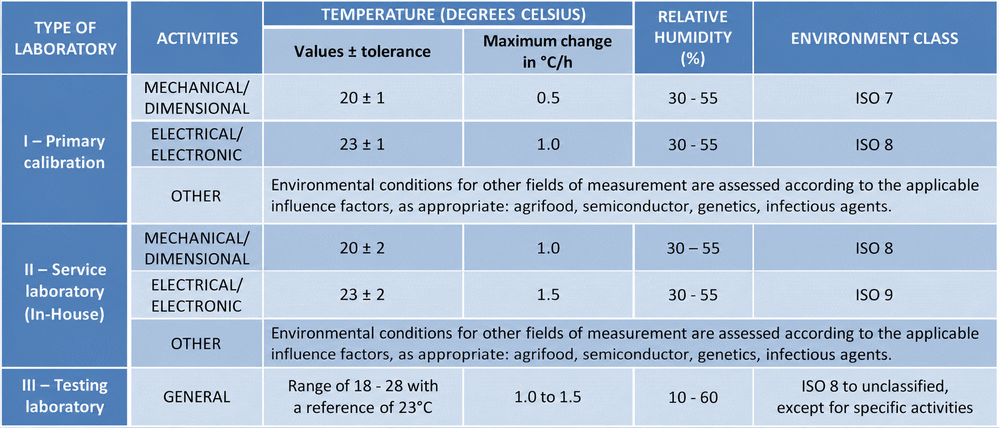
Environmental conditions are often specified by standards to ensure that testing and calibration activities are performed under optimal conditions.
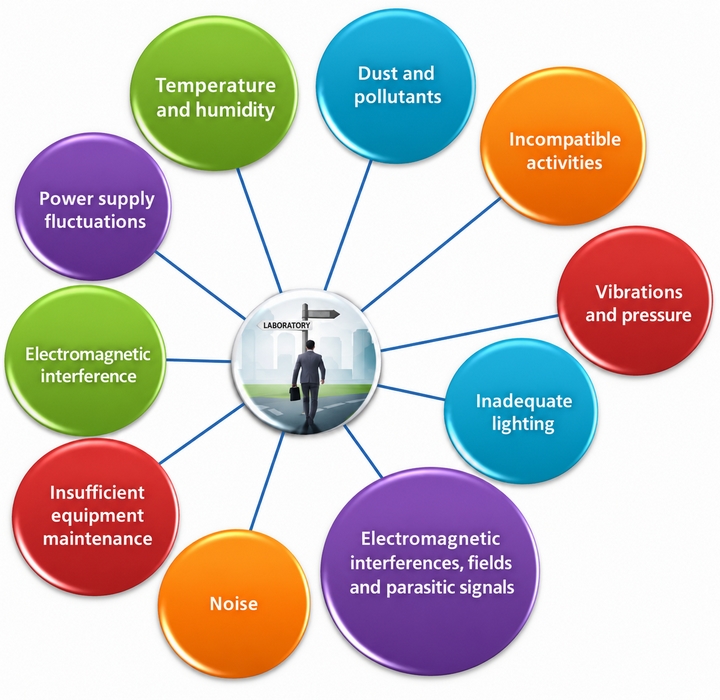
Measurement disturbances can arise from multiple sources that are sometimes difficult to eliminate completely. As a result, measurement conditions may deteriorate, leading to increased measurement uncertainty.
6.3 - Laboratory Facilities and Environmental Conditions
6.3.1 Facilities and environmental conditions shall be suitable for laboratory activities and shall not adversely affect the validity of results.
6.3.2 The requirements for facilities and environmental conditions necessary for performing laboratory activities shall be documented.
6.3.3 The laboratory shall monitor, control, and record environmental conditions in accordance with relevant specifications, methods, or procedures, or where they influence the validity of results.
6.3.4 Measures to control facilities shall be implemented, monitored, and periodically reviewed and shall include, but not be limited to:
a) Access to and use of areas affecting laboratory activities;
b) Prevention of contamination, interference, or adverse influences
on laboratory activities;
c) Effective separation between areas in which incompatible laboratory
activities are performed;

Calibration and testing equipment may be affected by changes in environmental conditions, including influence quantities such as temperature, pressure, and relative humidity.
Although laboratories may operate under different environmental conditions and, where appropriate, apply corrections to their measurement results to express calibration results under reference conditions, particular attention must be paid to activities performed at locations other than the laboratory's permanent facilities.
The overall operation of a testing or calibration laboratory is simplified when the same reference environmental conditions are maintained in metrology laboratories and at external customer facilities. This reduces the likelihood of errors during service activities or equipment operation.
Testing and working environments in general, as well as the associated
environmental and operating conditions, shall support the proper performance
of laboratory activities and shall not adversely affect the quality
of the tests performed, including sample preparation.
The laboratory shall identify and document acceptable limits and maintain
these conditions under control (through continuous monitoring and recording,
where necessary), paying particular attention to temperature, humidity,
dust or other contaminants, biological sterility, electromagnetic interference,
power supply quality, noise and vibration, lighting levels, and other
relevant factors.
Tests shall not be performed or, if already in progress, shall be stopped whenever the above conditions fall outside the established acceptable limits.
Effective separation shall be maintained between areas with different and mutually incompatible environmental conditions.
Appropriate precautions should be taken to prevent any changes, including accidental changes, to environmental conditions that may affect the quality of the tests performed (for example, as a result of unauthorized personnel entering controlled areas).
As a general rule, appropriate measures should be implemented to ensure effective laboratory management and good housekeeping practices.
The cleanliness of the laboratory will be assessed by the accreditation body's assessors.
If laboratory cleaning services are outsourced to an external cleaning
company, you must ensure that:
- The cleaning service contract clearly defines the responsibilities
and limitations of cleaning personnel, including an explicit prohibition
against touching laboratory equipment, materials, documents, or any
other items left on laboratory workbenches.
- A confidentiality clause is included in the contract to ensure the
protection of confidential laboratory and customer information.
For calibration laboratories that do not provide services to external customers, it is more cost-effective to establish a set of reference environmental conditions suited to local circumstances. However, appropriate consideration must be given to calibration data obtained from other sources under different environmental conditions.
For organizations performing on-site activities (metrology services, testing machine verification, etc.), the Conformity Assessment Body (CAB) shall ensure that environmental requirements are met and that environmental conditions do not adversely affect the validity of the results. This generally involves measuring temperature, relative humidity, and, where applicable, atmospheric pressure using their own measuring equipment.
For more sensitive equipment, several types of disturbances may influence measurement results:
An important consideration is the stability of environmental conditions throughout the time required to perform a calibration or verification. For example, the temperature should be established and maintained during calibration activities. Some standards explicitly require temperature readings to be recorded before and after calibration or verification.
The temperature stability requirement applies only to the area occupied by the reference equipment or measuring instrument. However, the larger the volume over which stable environmental conditions are maintained, the greater the confidence in the measurement results. In some cases, slightly relocating the work area can significantly improve measurement conditions.
With regard to temperature conditions, certain tests can achieve the
required performance only when the equipment is maintained in more tightly
controlled temperature environments, such as oil baths, controlled airflow
systems, or temperature-controlled chambers, where temperature stability
of ±5 °C or better can be maintained.
Many precision measurements can only be performed under such controlled
conditions to prevent temperature fluctuations, even in the most carefully
controlled laboratories.
If laboratory activities are limited to measurements performed under
these controlled conditions, variations in ambient temperature may occur
without adversely affecting the quality of the measurement results.
Relative humidity above approximately 65% is known to cause corrosion
of certain instruments or, in some cases, impair electrical insulation.
Below approximately 20%, electrostatic effects may begin to occur in
various ways, including electrostatic discharge (ESD), which can easily
damage sensitive electronic circuits.
According to ASTM standards, the calibration of hardness reference blocks
must be performed at a relative humidity below 70%.
or many calibration laboratories, air cleanliness is an important factor. One way to improve air cleanliness is to maintain a positive air pressure differential of at least 12 pascals (0.05 inches of water column) between the laboratory and adjacent areas outside the laboratory to reduce the ingress of dust particles.
Experience has shown that Class 50,000 and Class 100,000 laboratories require positive air pressure.
A Class 50,000 laboratory is representative of normal working conditions and typical laboratory occupancy, where the concentration of particles 0.5 micrometers or larger does not exceed 1.8 million particles per cubic meter of air: ISO Class 8 according to ISO 14644-1.
Activities within the laboratory that are not directly related to calibration work and that tend to generate airborne particles should not be permitted. Such activities include welding, smoking, eating and drinking, and housekeeping activities.
Lighting levels should be appropriate for the activities performed and maintained throughout the work area. An illuminance level of 500 to 1,000 lux is suitable for many laboratory activities.
Natural or induced vibrations present in the laboratory shall not compromise the validity of measurement results or adversely affect the service life of associated equipment.
To provide a comfortable working environment, ambient noise levels
should be maintained below 65 dB(A).
A-weighting is applied using a filter incorporated into the sound level
meter. This weighting provides a measurement that reflects the sensitivity
of the human ear to different sound frequencies.
A reliable electrical power supply is essential. It should provide
appropriate voltage and frequency, with minimal electrical distortion,
to ensure that the validity of measurement results is not compromised
and that the service life of associated equipment is not adversely affected.
For certain types of measurements, a regulated DC power supply may be
required. Alternatively, equipment may be connected to an uninterruptible
power supply (UPS) to minimize fluctuations and disturbances in the
electrical power supply.
Electric and magnetic field levels shall be maintained at levels that do not compromise the validity of measurement results.
Atmospheric pressure can influence certain measurements, but it is difficult to control in a laboratory environment. Metrologists must be aware of this influence and apply appropriate corrections to ensure that the validity of measurement results is not compromised (for example, during the calibration of microbalances).