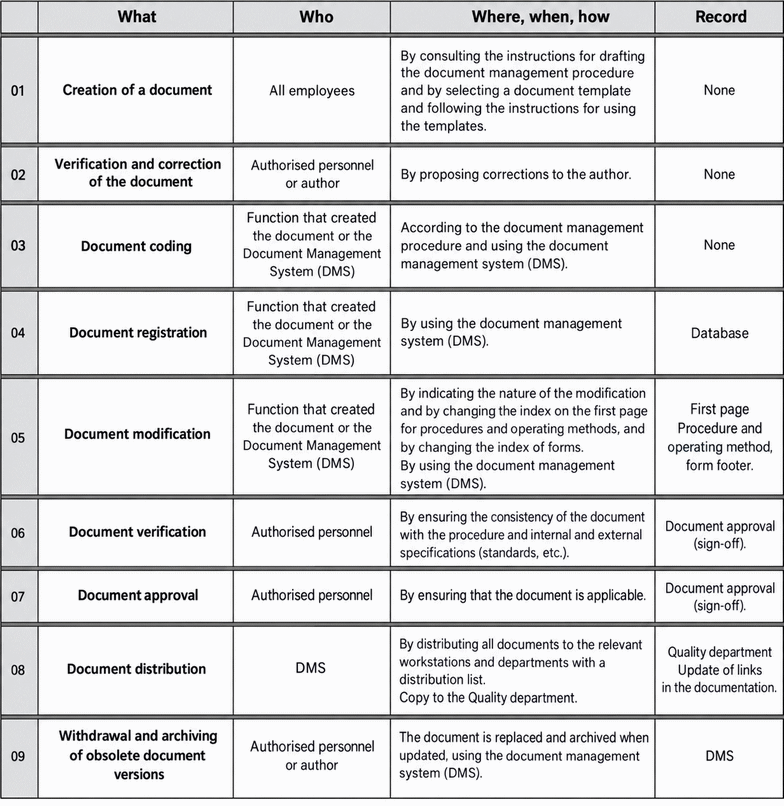
The documentation follows an established procedure to ensure that its drafting, review and approval are properly controlled and carried out by authorized personnel, and that it is made available to all relevant personnel..
The documents follow a well-established hierarchy that has proven effective, with a few adjustments to improve the understanding of input and output data.
8.3 - Control of Quality Management System Documentation
8.3.1 The laboratory shall control the documents (internal and external)
that relate to the fulfilment of the requirements of this International
Standard.
8.3.2 The laboratory shall ensure that:
a) documents are approved for adequacy prior to issue by authorized
personnel;
b) documents are periodically reviewed and updated as necessary;
c) changes and the current revision status of documents are identified;
d) relevant versions of applicable documents are available at points
of use and, where necessary, their distribution is controlled;
e) documents are uniquely identified;
f) the unintended use of obsolete documents is prevented, and suitable
identification is applied to them if they are retained for any purpose.

The Standard does not formally require a documented procedure for controlling
the conformity assessment body's (CAB) documentation.
The CAB must demonstrate that its operations comply with the requirements
of the Standard and its internal requirements, and that its management
system ensures these requirements continue to be met over a defined
period.
However, these requirements, and particularly the methods implemented
by the CAB to fulfil them, must be described. A documented procedure
may therefore be established, or an IT-based system may be used, provided
that its configuration requirements are formally defined.
- Ensure that authorized versions of documents are available at all
locations where they are needed for the proper operation of the laboratory
(for example, by making them accessible at one or more strategic locations);
- This issue can be easily addressed when documentation is managed electronically;
- Ensure that documents are reviewed and, where necessary, revised to
maintain their continued compliance with applicable requirements (preferably
annually; evidence of the review must be retained, even when no changes
are made);
- Ensure that invalid or obsolete documents are promptly withdrawn or,
at a minimum, made unavailable for use (responsibilities must be defined);
- Ensure that obsolete documents retained for legal purposes or for
the preservation of knowledge are appropriately identified (for example,
by applying an "OBSOLETE" stamp to paper documents or moving
electronic documents to dedicated archive folders).
The Standard does not require a master document list or any specific
tool for identifying and tracking the revision and distribution status
of documents and preventing the use of invalid or obsolete versions.
The Standard does not specify the methods to be used
for identifying documentation. Quality management system documents must
be uniquely identified, for example by indicating the issue date, revision
number, page number, total number of pages (or an equivalent indication
of the end of the document), and identification of the person responsible
for issuing the document (signature).
The most common methods for identifying changes within a document are
a vertical line in the left margin or highlighting the modified text
in a different colour (my preferred method, as it allows individual
words or groups of words to be identified, which is not possible with
a vertical line).
Handwritten amendments to controlled documentation are no longer permitted
under the established document control arrangements.
Documentation may be maintained in either paper or electronic format,
and the document control system must also cover documents managed electronically.
The documentation system is based on four different categories of documents,
depending on their context, use, maintenance and distribution:
- Documents required to describe and communicate the quality management
system, such as the quality policy.
- Documents required to formalize quality management system processes,
such as management review forms or internal audit forms.
- Documents required for the operation of the QMS, such as work instructions,
procedures, interactions between processes, etc.
- Documents required to verify or validate results and demonstrate the
effectiveness of the quality management system, such as process performance
indicators, quality control records, customer satisfaction surveys and
the evaluation of interlaboratory comparison results.
Regarding standards, the generally accepted practice is to allow three
months to purchase a new or revised standard, depending on the frequency
of your standards monitoring activities, followed by another three months
for its implementation. These timeframes naturally depend on your organization's
responsiveness and the type of document concerned.
As a reminder, a standard should only be considered fully implemented
within your organization once all planned actions required to comply
with its requirements (documentation updates, personnel training, equipment
modifications, etc.) have been completed.
Regarding documents issued by the accreditation body, its website specifies
the dates on which these documents become applicable. The implementation
periods are generally relatively short.
Regarding GLOBAL ACI documents referenced in the accreditation body's
documentation, you are not required to monitor them independently, as
this responsibility lies with the accreditation body, which must update
its own documents where necessary to reflect any changes.
The standard naturally supports a move towards paperless document management.
An Electronic Document Management System (EDMS) can meet all the applicable
requirements, provided that the specifications have been properly established
and the input requirements have been clearly defined.
Who has never dreamed of managing daily laboratory activities without
paper documents? This represents an advanced vision of digitalization,
supported by new technologies and software solutions such as ERP and
LIMS systems.
The main challenge lies in implementing these various solutions, defining
the desired scope of the "paperless laboratory" and determining
how to ensure the quality of services (reliability, traceability and
confidentiality), while complying with the requirements of accreditation
standards.
This approach generally requires substantial investment in equipment
and time to achieve the desired results.
We will examine an approach to managing processes, data and the quality
management system through the digitalization of laboratory information,
considering it as an integrated process rather than simply the implementation
of a new system, with the aim of improving overall efficiency.
Accredited organizations face the challenging task of maintaining effective
document management, regardless of laboratory size. Their documentation
may extend to hundreds of pages and require considerable time and effort
to manage.
Laboratories may use Microsoft Office applications, manufacturer-specific
equipment software, LIMS, ERP and electronic document management systems.
Together, these tools create a hybrid environment that may lead to discontinuities
in document management and data flows.
The first approach consists of adapting working practices to these different
tools. However, this is not a truly satisfactory solution, as its impact
on efficiency is generally limited and selective.
The second approach addresses these shortcomings by converting all paper
documentation into digital format. This improves traceability and information
retrieval but requires considerable effort to implement.
The most appropriate solution is more ambitious than simply introducing
a new software tool. It must provide sustainable improvements and achieve
the highest possible level of efficiency.
This approach is based on four main factors:
- Business requirements;
- User requirements;
- Technical considerations;
- Customer requirements.
Top management defines the project's objectives and vision and ensures
that the introduction of digitalization is also aligned with the laboratory's
return on investment (ROI) objectives.
This can be achieved by developing a mind map establishing cause-and-effect
relationships between objectives and expected benefits (time savings,
financial gains, business opportunities, knowledge retention, etc.).
In this way, project implementation will remain aligned with the laboratory's
objectives, and the cost-benefit analysis will address all relevant
factors.
The user's perspective is central to developing the paperless laboratory
concept.
The approach will be based on process descriptions and data flow mapping,
covering activities such as sample processing and reporting of results.
Support processes will also be mapped to optimize actual working practices.
For each process step, information will be collected from the systems
used, including all input and output data.
Performance indicators will be identified through an analysis of process
integration in relation to ROI.
A methodology must therefore be established to obtain quantitative information
from laboratory processes.
Data must be collected on the tasks performed, the time required and
the associated costs. Every stage of a laboratory service must be examined,
including sample preparation, preparation of solutions, equipment and
documentation preparation, calibrations, testing, measurements or analyses,
calculations, transcription and printing of results, report preparation,
review, printing, duplicate copies, distribution and archiving.
To achieve this, each member of staff could be equipped with a tablet
or smartphone running a time-tracking application capable of compiling
the results over a defined period, such as one month.
The objective is to produce a horizontal bar chart showing the different
tasks on the vertical axis and the corresponding percentages of working
time on the horizontal axis.
For example, five hours spent on preparation activities during a 39-hour
working week represents approximately 13% of working time.
In addition, tasks that do not directly generate test results must also
be considered, such as organization, nonconformity management, research,
training, management activities, maintenance, periodic verification,
meetings and responding to emails.
This analysis must be performed for each area of activity, with the
possibility of consolidating the results to obtain an overall view.
Naturally, this means eliminating manual data collection and transfer
wherever possible through interfaces between existing systems. Where
direct integration is not feasible, barcodes or QR codes can be used
to enable faster and more reliable data collection while reducing transcription
errors.
It also means eliminating redundant data and making source data available
in real time to every authorized user.
Possible scenarios may also include modifying existing IT systems by
adapting current applications to address functional gaps.
Based on the results presented in these charts, priority should be
given to the most time-consuming activities, considering the following
questions:
- Can this existing paper-based process be replaced with a digital process?
- Do we have the necessary knowledge and equipment to perform this task
without paper?
ROI (cost-benefit analysis) must remain a key consideration. There
is little value in implementing an unnecessarily complex system merely
to achieve a marginal improvement in efficiency.
Secondary tasks should be addressed at a later stage.
It is easy to understand that implementing a paperless approach is much
simpler when establishing a new activity. Retrofitting an existing laboratory
presents numerous obstacles, including outdated equipment, incompatible
software, unavailable software updates or technical upgrades, unsuitable
documentation and prohibitive implementation costs.
| Activities | Solutions | Benefits | Note |
| 6 - Resource Requirements
|
LIMS |
Confidentiality |
Competency Matrix |
| 6.3 - Laboratory Facilities and Environmental Conditions
|
LIMS |
Responsiveness |
Real-time Monitoring |
| 6.4 - Equipements
|
LIMS |
Traceability
within the Information System |
676
Technical Documentation |
| 6.5 - Metrological Traceability
|
LIMS |
Management of Certified Reference
Materials (CRMs) and Measurement Standards |
Automatic Data Collection |
| 6.6 -Externally Provided Products and Services
|
LIMS |
Speed |
 |
| 7.1 - Review of Requests
|
LIMS |
Speed |
Input Data Entered Only Once |
| 7.2 - Selection, Verification and Validation of Methods 7.11 - Control of Data and Information Management
|
LIMS |
Responsiveness |
Procedures and Work Instructions |
| 7.3 - Sampling
|
LIMS |
Speed |
Procédures |
| 7.4 - Handling of Test or Calibration Items
|
LIMS |
Speed |
Human Intervention |
| 7.5 - Technical Records 8.4 - Control of Records
|
ERP |
Speed |
On-site Recording |
| 7.7 - Ensuring the Validity of Results
|
LIMS |
Traceability |
Interlaboratory Comparisons |
| 7.8 - Reporting of Results
|
LIMS |
Speed |
tandards |
| 7.9 - Complaints
|
LIMS |
Real-time Monitoring |
Access by the Sales Department |
| 7.10 - Management of Nonconforming Work
|
LIMS |
Speed |
Quarantine |
| 8.2 - Management System Documentation 8.3 - Control of Management System Documents
|
Electronic Document Management
System (EDMS) |
Speed |
Documentation Accessible to All Personnel |
| 8.5 - Actions
to Address Risks and Opportunities
|
GED |
Consolidated Overview |
Automatic Data Collection |
| 8.6 - Improvement
|
LIMS |
Speed |
Documentation Accessible to All Personnell |
| 8.8 - Internal Audits
|
LIMS |
Speed |
Action Plans |
| 8.9 - Management Reviews
|
LIMS |
Traceability |
Dynamic Overview |