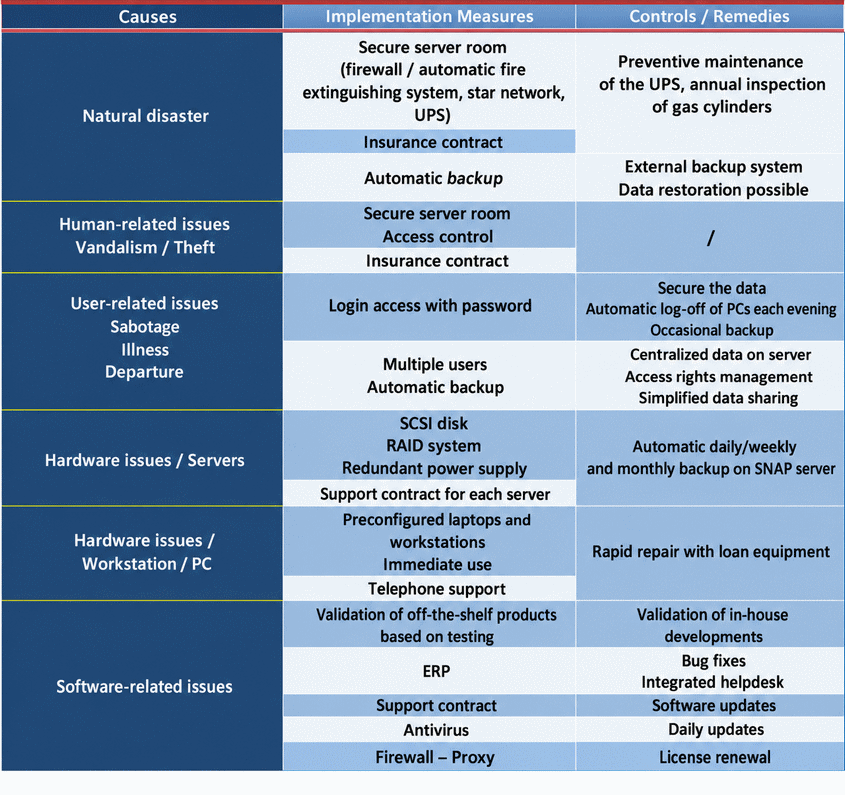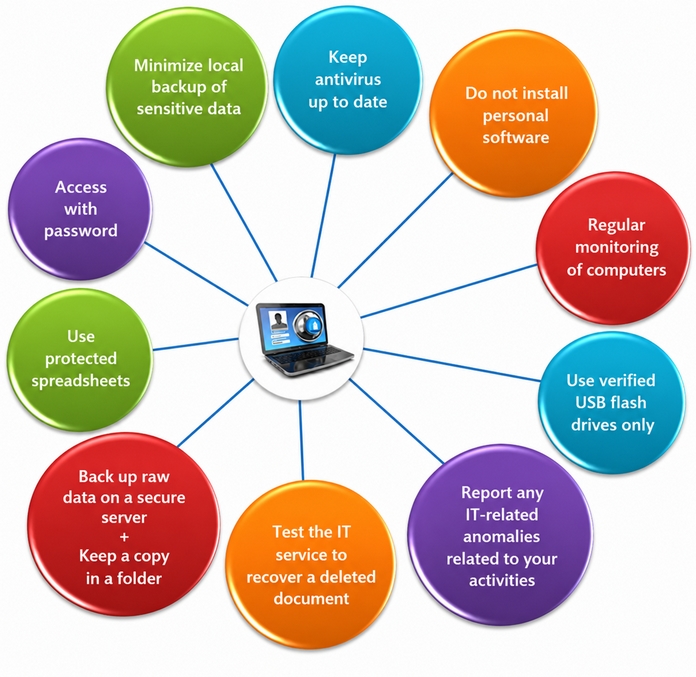
Networks and the entire IT working environment must be protected against unauthorized access and intentional or accidental damage, as a major IT incident could now prevent the laboratory from carrying out its activities.
A few good practices can help prevent data loss or accidental file modifications.
7.11 - Control of Data and Information Management
7.11.1 The laboratory shall have access to the data and information needed to perform laboratory activities.
7.11.2 The laboratory information management system(s) used for the collection, processing, recording, reporting, storage or retrieval of data shall be validated for functionality, including the proper functioning of interfaces within the laboratory information management system(s), by the laboratory before introduction. Whenever changes are made, including configuration or modifications to laboratory software based on commercial off-the-shelf software, they shall be authorized, documented and validated before implementation.
7.11.3 The laboratory information management system(s) shall:
a) be protected from unauthorized access;
b) be safeguarded against tampering and loss;
c) be operated in an environment that complies with provider or laboratory
specifications or, in the case of non-computerized systems, provide
conditions that safeguard the accuracy of manual recording and transcription;
d) be maintained in a manner that ensures the integrity of the data
and information;
e) include recording of system failures and the appropriate immediate
and corrective actions.
7.11.4 When a laboratory information management system is managed
and maintained off-site or through an external provider, the laboratory
shall ensure that the provider or operator of the system complies with
all applicable requirements of this International Standard.
7.11.5 The laboratory shall ensure that instructions, manuals and reference
data relevant to the laboratory information management system(s) are
readily available to personnel.
7.11.6 Calculations and data transfers shall be checked in an appropriate
and systematic manner.

All personnel must have access to all relevant documentation necessary
to properly carry out their laboratory activities.
Calculations performed and data transfers must be systematically checked.
When computerized systems are used for the acquisition, processing,
transfer, storage and retrieval of test and measurement data, for the
preparation of test reports, and for other operations associated with
testing activities (e.g., sample management), the following requirements
apply:
- Software developed by the user (the laboratory) must be documented
and verified as fit for its intended purpose;
- Appropriate measures must be implemented to protect data integrity
and confidentiality during generation, storage, transmission, processing,
etc.;
- A two-level protection system is recommended: protection against unauthorized
access and individual protection of each document, file or group of
files;
- Computers and automated systems must be carefully maintained to safeguard
data integrity;
- Personnel must be trained in the use of these systems;
- System functionality must be verified regularly and following any
modifications;
- Reports prepared and transmitted electronically must include identification
of the issuing organization and the technical person responsible for
the report;
- Electronic records must be password-protected and read-only (operators
must not be able to print a document after modifying its contents, even
if they do not have permission to save those modifications).
The storage of paper records by an external organization independent of the conformity assessment body (CAB) must be subject to verification, with objective evidence demonstrating compliance with the applicable requirements of the Standard.
Computer Systems:
Computers and associated software can clearly affect the validity of
data and must therefore be properly managed and controlled, whether
they form part of the instrumentation or are simply used to store and
process data. This applies to all hardware and software, particularly
software developed in-house or applications created using spreadsheets,
for example.
Software Verification:
A designated person must be responsible for authorizing the software
that may be used within the laboratory.
This person must ensure that the software has been verified to demonstrate
that it will not corrupt data or other information before being put
into service. This requirement must apply not only to new software but
also to all updates and modifications.
The designated person must be the laboratory manager or an individual
to whom the laboratory manager has delegated this responsibility.
There is no reason why personnel should not be allowed to create spreadsheets,
for example, to perform routine calculations or data processing. However,
these spreadsheets must be verified and authorized before use.
It is not acceptable for personnel to develop ad hoc applications and
use them without the approval of laboratory management. Whenever possible,
spreadsheets should be protected against unauthorized modifications
using passwords controlled by management.
Where this is not possible, a set of input and output reference data
must be available. These data can be entered into the spreadsheet to
verify that the calculated values are correctly determined.
All new software and modifications to existing software, including new
versions of commercial software, must be recorded in a software management
register, together with their implementation dates. This makes it possible
to identify which software version was used at a particular time if
an error needs to be investigated.
Regular checks of installed software must be performed, and any unauthorized
software must be removed.
It must also be possible to reinstall previous versions of any software
in the event of an error or when an investigation is required to determine
whether the software was responsible.
The simplest way to provide this capability is to ensure that, whenever
software is updated, a copy of the previous version is retained on removable
storage media, such as an external hard drive, or on a server.
Computer Networks:
Laboratories are increasingly using local area networks (LANs), particularly
when operating a Laboratory Information Management System (LIMS). Such
networks can facilitate software control by establishing restricted
work areas with different access levels. These networks should be used
to control, for example, who is authorized to create new files on the
network server.
In many cases, the laboratory does not have direct control over the
network server because it is managed by another department as part of
the company's overall IT infrastructure.
Laboratory management must demonstrate to assessors that it is aware
of the activities carried out on the network on its behalf and that
it is informed of software updates so that appropriate verification
can be performed.
The most convincing way for the laboratory to demonstrate its commitment
is to establish a written agreement between the laboratory and the network
administrator, clearly defining the allocation of responsibilities.
This agreement should cover at least the following points:
The network administrator must agree to consult laboratory management
and obtain its approval before installing any new software accessible
to laboratory personnel.
Where necessary, laboratory management must retain the right to perform
software verification before approving its use.
The network administrator must undertake to inform the laboratory of
any planned updates or modifications to software used by the laboratory.
It must be clearly established that the network administrator will ensure
that the laboratory has completed its required checks before the revised
software is put into operation.
The key is to clearly define the responsibilities of each party to prevent
inadequate controls arising from both parties assuming that the other
is responsible.
Responsibility for ensuring the ability to roll back to a previous software
version must be clearly agreed upon.
In particular, the network administrator must know who is authorized
to request software modifications on behalf of the laboratory and must
not act on requests from unauthorized laboratory personnel.
Arrangements for backing up laboratory data stored on the network must
also be agreed upon.
Data Integrity on Computers:
When a laboratory manages data on computers, specific precautions must
be taken, particularly regarding data security and the control of data
modifications.
There may be perfectly legitimate reasons for a laboratory to modify
previously recorded data, for example, when repeated measurements produce
a different result.
The first question the laboratory must address is whether the electronic
record constitutes raw data, i.e., data recorded at the time of observation.
This may be the case when data are recorded directly from an instrument
into a computer.
If data are initially recorded in a laboratory notebook before being
transferred to a computer, the paper document constitutes the original
raw data.
Raw data must be preserved as part of the laboratory's records.
Where data are manually transferred to a computer, the laboratory
must demonstrate to assessors that adequate safeguards are in place
to verify the accuracy of the transfer and that, once the transfer has
been completed and verified, any subsequent changes to the data are
controlled in accordance with the requirements of the Standard.
Manual data entry into computers is clearly a potential source of error.
Ideally, all such transfers should be verified by a second person.
In critical cases, double data entry may be implemented, whereby the
same data are entered twice to create two separate files that can subsequently
be compared using appropriate software.
It is the laboratory's responsibility to demonstrate to assessors that
reasonable measures have been implemented to verify that data are entered
correctly.
At a minimum, the laboratory must verify entered data and implement
measures to prevent errors.
The network administrator must know who is authorized to request modifications.
A more fundamental issue arises when computer systems allow data to
be modified without leaving any trace of the changes or preserving the
original record.
This conflicts with the fundamental requirement that all modifications
must be traceable to the individual who made them and that the original
values must remain retrievable.
Software specifically designed for laboratory applications generally
includes an audit trail that records modifications and identifies the
person responsible through their username.
Such software can normally retain the original record and may also require
the user to provide a reason for the modification.
Where an audit trail is available, the laboratory can demonstrate compliance
with the Standard, provided that audit trail records are retained and
reviewed as part of its quality control arrangements.
Software not specifically designed for laboratory applications, or not
compliant with 21 CFR Part 11, generally does not provide this type
of audit trail.
The simplest approach is to establish a rule requiring all data modifications
to be documented in the relevant test report file.
The record must specify the identity of the person making the modification,
the date of the modification, the reason for the change, and both the
original and revised values.
Although simple, such a system does not necessarily guarantee compliance
with the Standard because, in most situations, it does not provide a
fully auditable record.
If someone modifies raw data on a computer without documenting the modification,
the change may remain undetected.
However, if the original raw data are retained on a worksheet, any
discrepancy between the worksheet and the electronic record can be identified.
In this case, the system is verifiable and may be considered acceptable.
This highlights the importance of clearly defining what constitutes
raw data.
Electronic data may be protected against alteration through software
controls, for example, by assigning read-only status once the information
has been entered.
The laboratory must establish clear rules defining who is authorized
to modify data.
If authorization to modify data is restricted to personnel with an appropriate
level of technical responsibility, assessors are more likely to consider
the arrangements satisfactory.
An inconsistency between the laboratory's records and the information
presented in the test report could constitute a critical nonconformity.
Specific procedures must be followed when test reports require amendments,
and both the original and modified data must remain available.
It must also be possible to issue an amended version of the original
report incorporating the modified data while complying with the requirements
of the Standard.
The need to amend a report may also require a nonconformity record and
appropriate corrective actions.
If data have been modified electronically but the corresponding worksheet
has not been updated, a significant risk arises because it may become
impossible to determine which data are valid.
A dated and initialed correction on the original worksheet, clearly
identifying the change and maintaining traceability to the original
entry, can help resolve this issue.
Computers Integrated into Laboratory Instrumentation:
Computers that control laboratory instruments and collect data from
them must be treated as an integral part of the instrument and verified
as part of the complete system.
Software upgrades must be treated in the same way as any other modification
to the instrument and must be verified before being put into use.
Particular care must be taken when instruments are installed or serviced
by the supplier, as service engineers frequently install software patches
and make modifications. Laboratory management must be informed of all
software changes so that they can be verified and recorded in the equipment
history log.
Computers integrated into laboratory instruments can provide an excellent
means of retaining raw data in a compact, proprietary format.
For example, chromatography data may be difficult to reproduce fully
on paper, but they can be archived electronically on CDs.
However, secure backups on a server are preferable to ensure that the
data can be recovered when needed.
Software interfaces or data conversion tools may also be necessary
to enable data to be read on another instrument or computer system.
For example, consider a situation in which a chromatography instrument
breaks down and cannot be repaired because it is an obsolete model and
critical spare parts are no longer manufactured or available. The laboratory
had anticipated this situation and had already invested in a replacement
instrument.
Following a customer's complaint arising from repeat testing, the laboratory
needs to review results originally obtained using the previous instrument.
However, it is impossible to determine whether the discrepancy resulted
from an equipment malfunction or incorrect configuration by the operator
because the original data files cannot be read using the new equipment.
Laboratory Information Management Systems (LIMS):
The use of Laboratory Information Management Systems (LIMS) is becoming
increasingly common and can make a significant contribution to the effective
operation of a quality management system.
Some systems can even incorporate equipment calibration intervals, preventing
the entry of data generated by instruments whose calibration is overdue.
However, LIMS may sometimes introduce errors or limitations and may
not provide exactly the functionality required by laboratory management.
When an operator is logged into the system, it must be capable of automatically
logging out or locking the session after a defined period of inactivity
to prevent unauthorized personnel from accessing or modifying information.
If a second operator is authorized to use the system and modify data,
that operator must be able to formally identify themselves within the
system before performing any actions.
Backing Up Data on Computers:
In general, a laboratory is responsible for ensuring that all data under
its control are adequately protected, particularly raw data and information
essential to traceability. When a laboratory stores raw data on computers,
the backup system must be extremely robust.
The backup policy must ensure that, in the event of a system failure
resulting in the permanent loss of data that have not yet been backed
up, the laboratory can recover the information, either from worksheets
or by repeating the tests.
In extreme cases where a laboratory performs tests that cannot be repeated
and the only copy of the raw data is stored on a computer, backups must
be performed very frequently.
A common strategy is for laboratories to maintain two separate storage
locations: the primary computer and a network server.
The backup storage area should be physically separated from the laboratory
by a fire-resistant barrier and, ideally, equipped with a fireproof
safe specifically designed for data storage.
Fireproof safes intended for paper documents are not suitable for electronic
storage media, as the internal temperatures reached during a fire may
be high enough to destroy the data.
If backup media must be kept within the laboratory, a suitable fireproof
safe is essential, and access to it must be strictly controlled.
Today, secure off-site servers are available that allow the system to
automatically upload all data generated during the day on a daily basis.
The advantage of this approach is that it can provide for the recovery of laboratory data within 24 hours, provided that appropriate backup, recovery and restoration arrangements have been established and verified.
Prevention is better than cure!