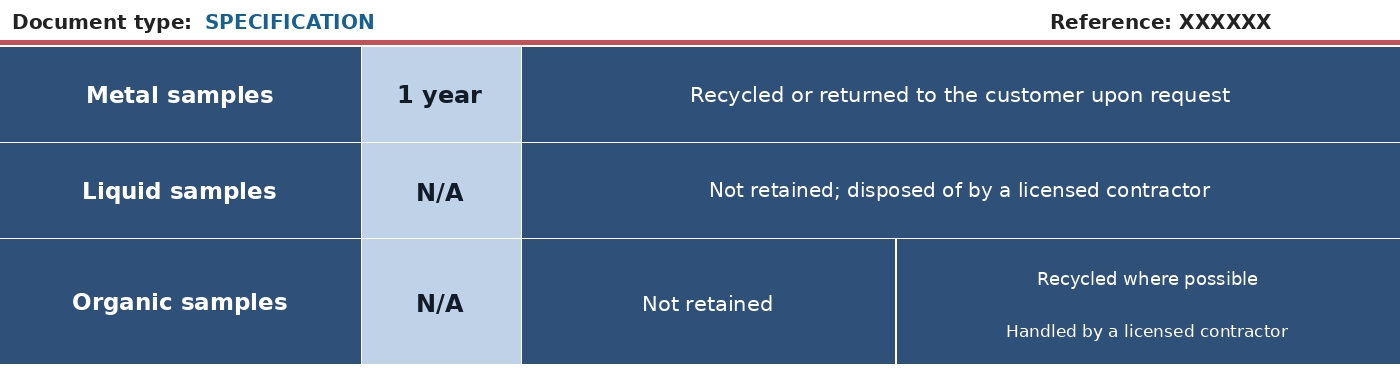
Sample retention periods must be clearly documented, and in certain specific cases, the methods of disposal must also be defined. Customers must be informed of the applicable retention period if they do not wish to have their samples returned.
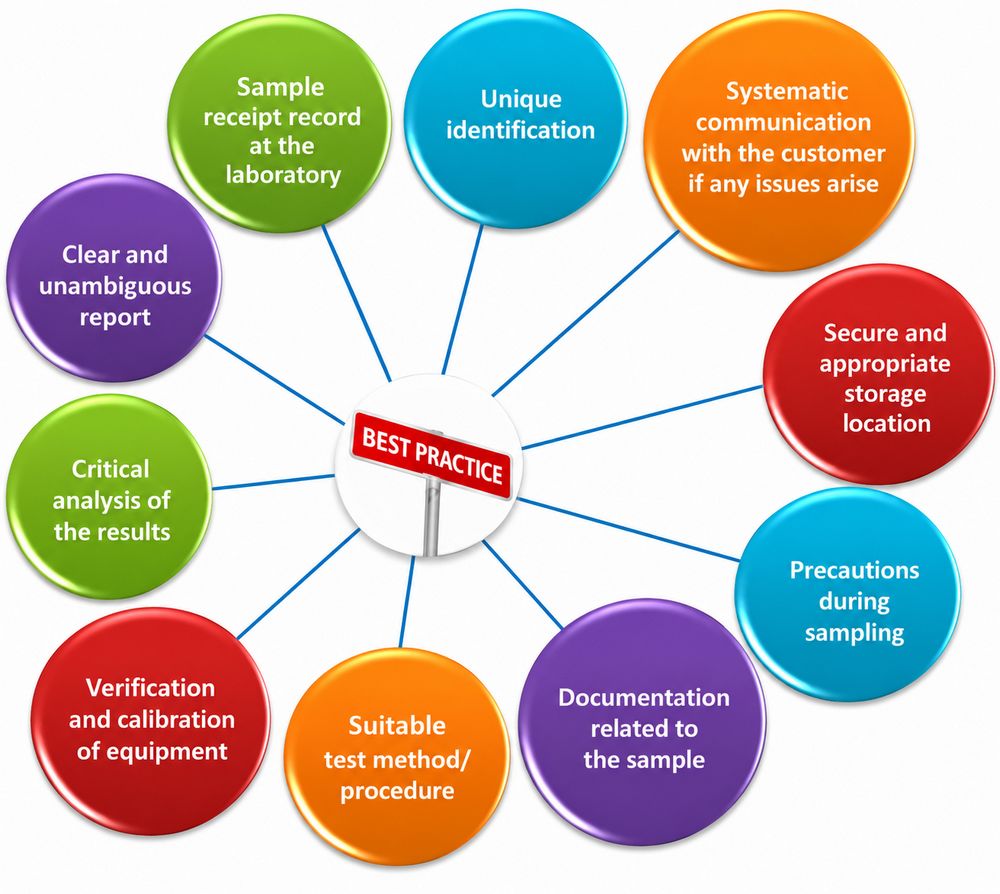
Errors within the laboratory can be prevented by implementing best practices. Personnel must be regularly reminded of these practices to prevent deviations over time, and newly recruited personnel must receive appropriate training.
7.4 - Handling of Test Items
7.4.1 The laboratory shall have a procedure for the transportation, receipt, handling, protection, storage, retention, and disposal or return of test or calibration items, including all provisions necessary to protect the integrity of the test or calibration item and the interests of the laboratory and the customer. Precautions shall be taken to avoid deterioration, loss or damage to the item during handling, transportation, testing or calibration, storage/waiting, and preparation. Handling instructions provided with the item shall be followed.
7.4.2 The laboratory shall have a system for the unambiguous identification
of test or calibration items.
The identification shall be retained while the item is under the responsibility
of the laboratory. The system shall be designed and operated so as to
ensure that items cannot be confused physically or when referred to
in records or other documents. When appropriate, the system shall accommodate
a subdivision of an item or groups of items and the transfer of items
within or outside the laboratory.
7.4.3 Upon receipt of the test or calibration item, deviations from
specified conditions shall be recorded. When there is doubt about the
suitability of an item for testing or calibration, when an item does
not conform to the description provided, or when the requested test
or calibration is not specified in sufficient detail, the laboratory
shall consult the customer for further instructions before proceeding
and shall record the results of this consultation.
When the customer requests that the item be tested or calibrated while
acknowledging a deviation from specified conditions, the laboratory
shall include a disclaimer in the report indicating which results may
be affected by the deviation.
7.4.4 When items need to be stored or conditioned under specified environmental conditions, these conditions shall be maintained, monitored and recorded.

The laboratory must establish appropriate procedures for the transportation,
delivery, handling, protection, storage, retention and, where applicable,
safe disposal of test items.
It must also implement the necessary measures to preserve the integrity
of these items and protect the interests of both the laboratory and
its customers.
Test items must be appropriately identified, and this identification
must be maintained throughout the entire period during which the items
remain under the laboratory's responsibility.
The identification system must prevent any confusion, both physically
and in documentation, and must ensure control not only over transfers
into and out of the laboratory but also over movements between different
sections within the laboratory.
Upon receipt of test items, any anomalies or deviations from specified
conditions must be recorded.
In cases of doubt or nonconformity, the laboratory must request additional
instructions from the customer and retain a record of these instructions.
It must be clearly established whether sample preparation has already
been performed by the customer or whether it is to be carried out by
the laboratory.
The laboratory must implement appropriate measures to prevent deterioration
or damage to test items during their movement, storage or preparation
for testing.
Where specific storage or preservation conditions are required, these
conditions must be provided, maintained, monitored and recorded by the
laboratory.
The laboratory must ensure the security and integrity of items belonging
to the customer.
It must also protect them against any unauthorized interference.
If the customer deliberately requests a deviation from the applicable
standard or the internal procedure used by the conformity assessment
body (CAB), the test report or certificate must include an appropriate
disclaimer identifying the results that may be affected and indicating
that their validity could be compromised to a greater or lesser extent.
Samples submitted to the laboratory are received in a designated area
(such as dedicated containers, floor-marked areas or a sample processing
room).
Samples must be accompanied by a document providing, at a minimum, information
on the nature of the samples, the purpose of the testing and the sample
references.
This information enables the samples to be registered in the laboratory's
test management system or Laboratory Information Management System (LIMS),
where a unique identification number is assigned sequentially to each
sample.
The person authorized to receive samples verifies that the packages
received conform to the descriptions provided in the purchase order
and quotation.
They inspect and, where appropriate, record the condition of the samples
and verify the following information: quantity of items, sample identification
numbers (batch, heat number, etc.), identification of the material or
product, requested tests or analyses, and storage conditions.
If the information accompanying the received samples is considered
incomplete, the person must notify the personnel responsible for performing
the laboratory activities.
Any modifications or additional instructions are recorded in the sample
tracking form or Laboratory Information Management System (LIMS).
If a sample does not correspond to the description provided in the request,
it is placed on hold pending clarification from the customer. If satisfactory
clarification cannot be obtained, the sample is temporarily stored or
returned.
If a sample is rejected for technically justified reasons (damaged,
broken, cracked container, spilled liquid sample, etc.), the reason
for rejection is documented in the LIMS or sample tracking system, in
accordance with the applicable work instruction or procedure.
The sample may be returned to the customer.
All records and documents received with the sample must be included
in the administrative file associated with the laboratory's test report.
The customer is informed verbally or electronically of the reason for
rejection and consulted regarding the measures required to proceed with
the requested laboratory activities.
The customer may provide additional instructions allowing the sample
to be processed, where appropriate.
All communications must be documented.
Samples Storage:
Samples awaiting analysis are placed in designated storage locations
assigned by the person responsible for the samples, in accordance with
the instructions provided with the samples or the laboratory's internal
work instructions.
Samples are stored frozen, refrigerated, or at room temperature, as
appropriate.
Hazardous substances are stored in a separate, locked area.
Sample storage areas are organized and monitored to prevent contamination
or cross-contamination.
Each laboratory must establish a procedure for monitoring the storage
of specific samples requiring special precautions.
Transfer of Samples Outside the Laboratory:
Samples or portions of samples transferred outside the laboratory must be recorded in the sample tracking system or Laboratory Information Management System (LIMS).
The following information must be documented:
- What was provided and in what quantity;
- How the sample was prepared for shipment;
- How the sample was identified and, where applicable, sealed;
- The recipient of the sample and the date of shipment.
All this information is documented in the laboratory service tracking
form and the sample tracking system, or recorded directly in the LIMS.
Samples must be shipped in accordance with applicable work instructions
and regulations to ensure that their integrity and condition are preserved
during transportation.
Sample Storage During Analysis:
Samples are kept under appropriate supervision while in the laboratory's
custody and maintained under suitable storage conditions.
This may require cold rooms, refrigerators, temperature- and humidity-controlled
chambers, ventilated storage cabinets for acids, bases or solvents,
airtight containers to prevent contamination of the laboratory environment,
storage under a fume hood, or desiccators.
Specific storage and environmental conditions must be recorded, with appropriate traceability maintained.
Sample Disposal:
This issue primarily concerns testing laboratories, since equipment
submitted for calibration is normally returned to the customer.
In such cases, the laboratory is responsible for ensuring that the equipment
is properly packaged and transported to preserve the integrity of the
calibration.
Testing laboratories must establish a clear policy defining sample retention
periods.
Whenever possible, samples should be retained for a defined period
after the test report has been issued, in case questions arise that
could be resolved through additional testing.
However, retention may be impractical due to limited storage space,
the large size of test items, or other constraints. The laboratory may
therefore reserve the right to dispose of samples immediately when their
retention serves no technical purpose.
ISO/IEC 17025 does not specify a minimum sample retention period.
However, retaining samples for one to three months after the test report
has been issued is a common practice when retesting is technically relevant.
Customers must be informed of the laboratory's sample retention policy,
for example, through its standard terms and conditions, quotations,
or contract review process, to avoid misunderstandings.
The authority to approve sample disposal must be clearly documented,
and all disposal activities must be recorded using a dedicated form
or in the Laboratory Information Management System (LIMS).
Samples requiring special handling or disposal must be disposed of in
accordance with applicable regulations.
The disposal method must be appropriate to the nature of the samples and must prevent unauthorized third parties from retrieving them, in order to protect confidentiality and ensure safety.