An effective and appropriate response may help retain a customer, but above all it demonstrates professionalism under all circumstances, which is not always the case.
A dedicated form is not mandatory; a nonconformity report can also be used to handle customer complaints.
7.9.1 The laboratory shall have a documented process for receiving, evaluating, and making decisions on complaints.
7.9.2 A description of the complaints-handling process shall be made available to any interested party upon request.
Upon receipt of a complaint, the laboratory shall confirm whether the complaint relates to laboratory activities for which it is responsible and, if so, shall address it.
The laboratory shall be responsible for decisions at all levels of the complaints-handling process.
7.9.3 The complaints-handling process shall include at least the following elements and methods:
a) a description of the process for receiving, validating, and investigating a complaint, and deciding what actions to take in response;
b) tracking and recording complaints, including actions taken to resolve them; and
c) ensuring that any appropriate action is taken.
No laboratory serving external customers is entirely free from customer questions or complaints.
The laboratory is required to record all customer complaints, systematically investigate them, and document both the investigation findings and any corrective actions taken.
Complaints provide valuable external feedback for assessing how effectively the quality management system operates.
The primary objective of the quality management system (QMS) is to ensure customer satisfaction.
7.9.4 The laboratory receiving the complaint shall be responsible for gathering and verifying all information necessary to validate the complaint.
The laboratory should treat customer complaints as a source of information requiring investigation, just like any other quality-related incident. If the complaint is unfounded, it should still be recorded, together with supporting evidence documenting why the issue is considered minor or unsubstantiated.
If the complaint is justified, the laboratory must be able to provide records showing what corrective actions were taken to resolve the problem and, more importantly, what was done to reduce the likelihood of recurrence.
Quality personnel should also follow up to verify that the action taken was effective.
7.9.5 Whenever possible, the laboratory shall acknowledge receipt of the complaint and provide the complainant with progress updates and the outcome.
7.9.6 The conclusions communicated to the complainant shall be made, or reviewed and approved, by individuals who were not involved in the laboratory activities that were the original subject of the complaint.
The laboratory’s quality documentation should clearly identify personnel independent of the activity who are authorized to approve responses to complaints.
The designated individual should carefully review the response and assess whether corrective actions already taken or planned are adequate, or whether further investigation and corrective action are necessary.
Overall, authorized personnel are responsible for ensuring that the complaint was handled properly, corrective actions addressed the root cause, and lessons learned were incorporated into the quality system.
In most cases, quality personnel are authorized to fulfill this role, generally in coordination with laboratory management.
7.9.7 Whenever possible, the laboratory shall formally notify the complainant when the complaints-handling process has been completed.
Avoid taking too long to close complaints, as this can hinder continual improvement throughout the system. An immediate response is not necessarily the best one (due to insufficient reflection, blame, or frustration), but if the issue has almost been forgotten, actions may address the problem too broadly without identifying its actual cause.
Responses to customer satisfaction surveys may also reveal complaints that were not addressed or were handled unsatisfactorily.

Definition of a complaint: any expression of dissatisfaction addressed to an organization, concerning its products or its complaints-handling process, for which a response or resolution is explicitly or implicitly expected.
Confidentiality
Personal information about the complainant should be made available within the organization only when necessary to handle the complaint and should not be disclosed without the express consent of the customer or complainant.
Complaints may be received through various channels: regular mail, email, telephone, fax, or a customer visit.
Complaints may originate from:
Internal customers in other departments who use laboratory services;
External customers that contract services to the laboratory (private companies, public organizations, or other laboratories).
Complaints may be classified by their origin and their impact on work quality or customer service.
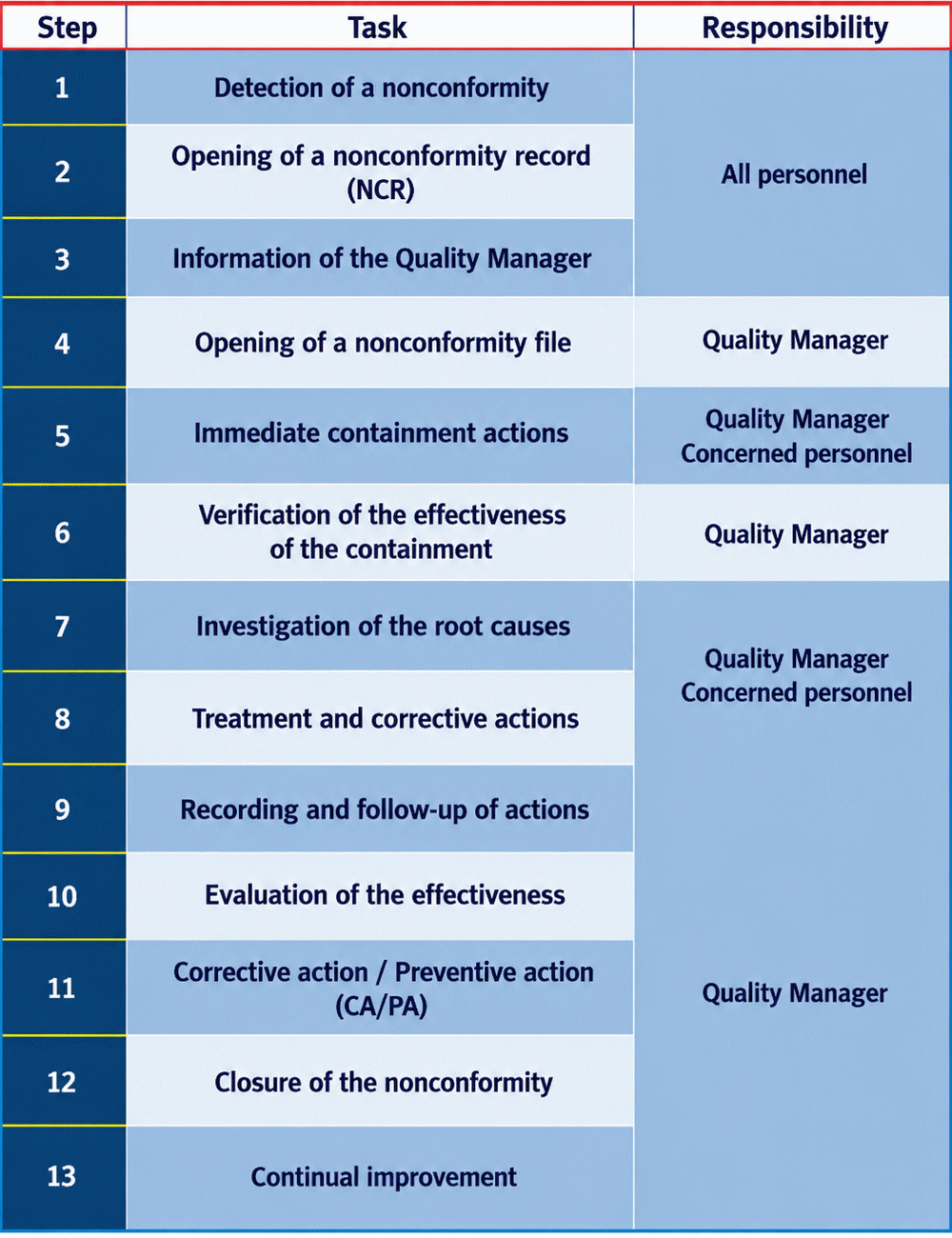
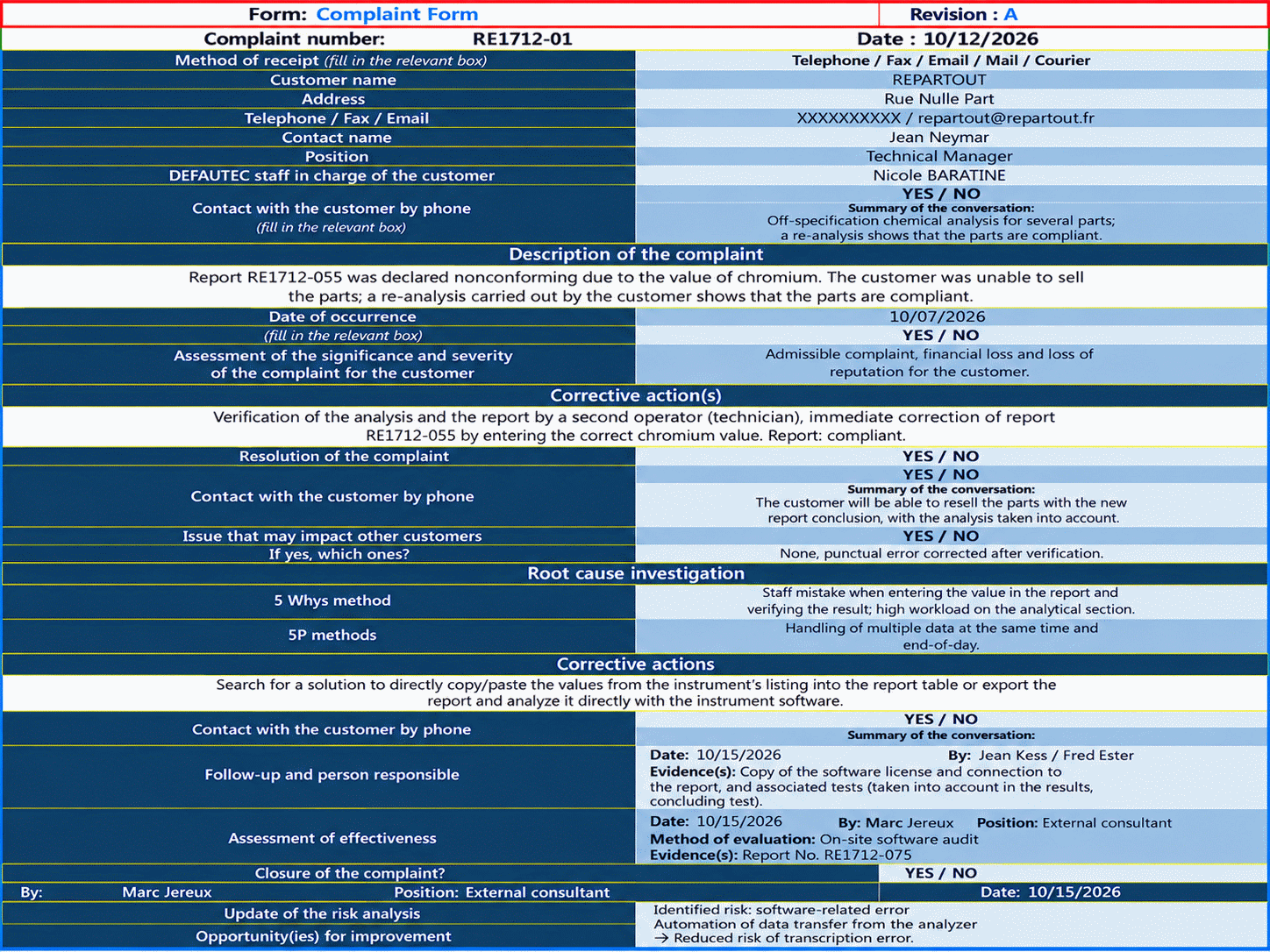
Any employee receiving a complaint must document it and report the issue using an appropriate form (complaint-handling, nonconformity, or incident report).
At a minimum, record:
The name of the person who received the complaint, the organization that submitted it, and the name of its contact person;
The date the complaint was received;
The nature of the complaint;
The response deadline and, where applicable, the requested resolution and any immediate action taken.
If the person receiving the complaint can identify its cause and the appropriate corrective measures, that person should implement the corrective measures, complete the form, and forward it to the designated person for review of the response.
If the person receiving the complaint cannot determine the cause and appropriate corrective measures, the matter must be discussed with laboratory management and all personnel concerned.
A corrective action report is then issued, and the laboratory’s corrective action process is initiated.
This process includes identifying and investigating adverse effects on past and future services, along with actions implemented for continual improvement.
Once all corrective measures have been completed, the complaint is closed.
All documentation used to address the complaint is archived by the quality department.
Complaints are reviewed during internal audits to verify that the responses were appropriate, effective, and timely. They are also considered during management review in order to:
a) ensure that the complaints-handling process is effective and that objectives are established for the appropriate functions within the organization;
b) ensure that the complaints-handling process is properly planned, designed, implemented, and updated in accordance with the organization’s complaints-handling policy;
c) identify and allocate additional resources, where necessary, to make the complaints-handling process more effective and efficient;
d) ensure that all personnel understand the complaints-handling process and the need to foster a customer-focused culture within the organization;
e) ensure that information about the complaints-handling process is communicated to customers, complainants, and, where appropriate, other directly concerned parties in an easily accessible manner.