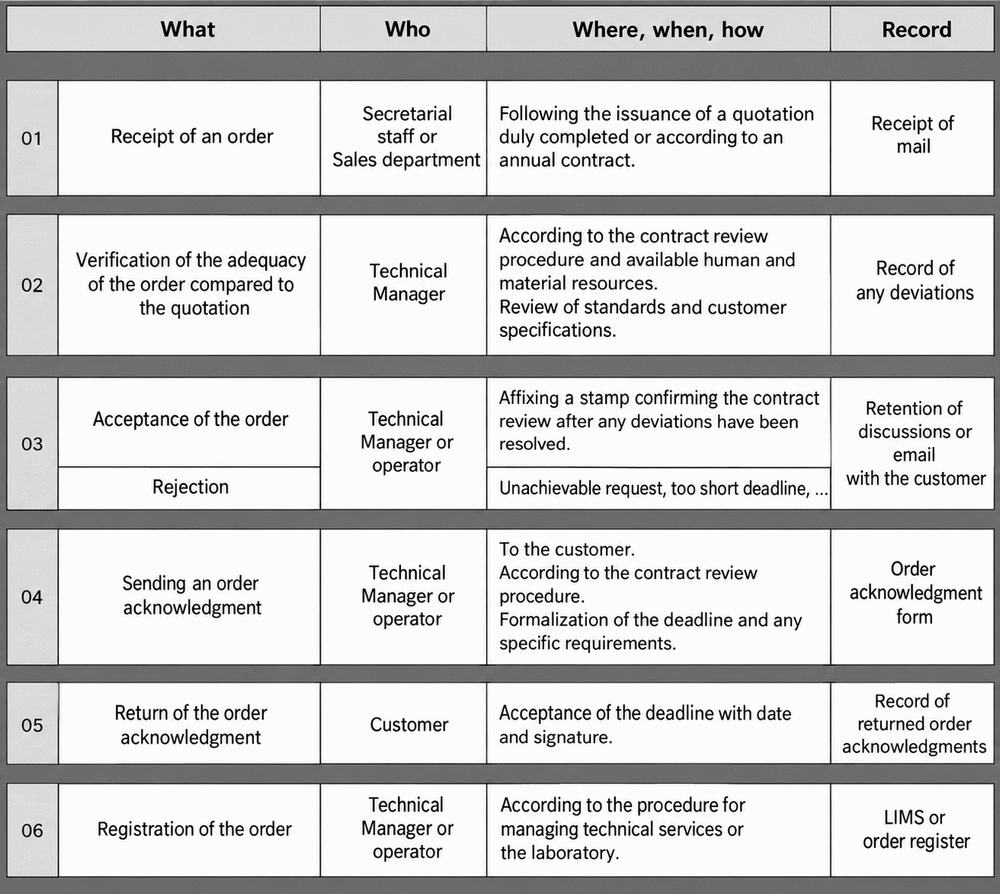
It follows an established procedure that must be followed regardless of the type of customer.
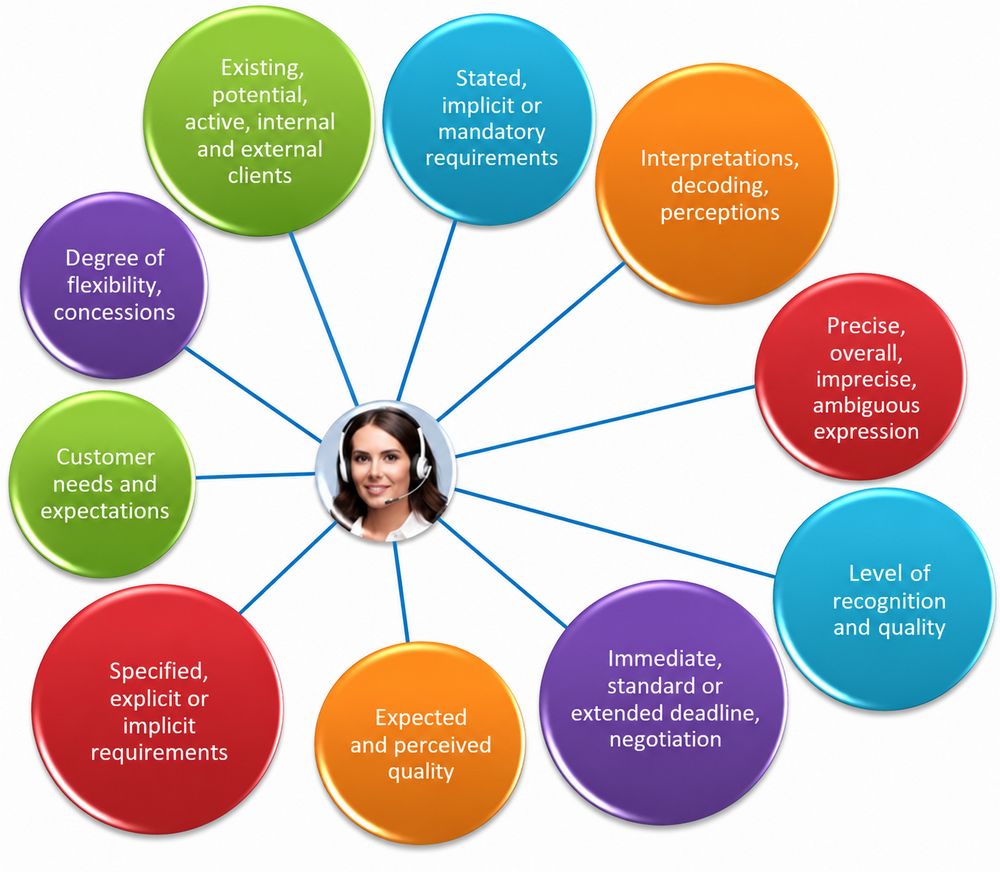
Customer expectations vary considerably. Some ask for a great deal, while others are satisfied with the results alone. All of these requirements must be addressed.
7.1 Review of requests, tenders, and contracts
7.1.1 The laboratory shall have a procedure for reviewing requests, tenders, and contracts. The procedure shall ensure that:
a) the requirements are adequately defined, documented, and understood;
b) the laboratory has the capability and resources to meet the requirements;
c) when external providers are used, the requirements of 6.6 are applied, the laboratory advises the customer of the specific laboratory activities to be performed by the external provider, and obtains the customer’s approval;
d) appropriate methods or procedures are selected and are capable of meeting the customer’s requirements.
7.1.2 The laboratory shall inform the customer if the requested method is considered inappropriate or out of date.
7.1.3 When the customer requests a statement of conformity to a specification or standard for the test or calibration (for example, pass/fail, in tolerance/out of tolerance), the specification or standard and the decision rule shall be clearly defined. Unless the decision rule is inherent in the requested specification or standard, the selected decision rule shall be communicated to and agreed upon with the customer.
7.1.4 Any differences between the request or tender and the contract shall be resolved before laboratory activities begin. Each contract shall be acceptable to both the laboratory and the customer. Deviations requested by the customer shall not compromise the integrity of the laboratory or the results.
7.1.5 The customer shall be informed of any deviation from the contract.
7.1.6 If a contract is amended after work has begun, the contract review process shall be repeated, and any amendments shall be communicated to all affected personnel.
7.1.7 The laboratory shall cooperate with customers or their representatives in clarifying the customer’s request and monitoring the laboratory’s performance of the work.
7.1.8 Records of reviews, including any significant changes, shall be retained. Records of relevant discussions with a customer regarding the customer’s requirements or the results of laboratory activities shall also be retained.

The laboratory shall establish and maintain appropriate procedures for reviewing requests for quotations received (or service requests), quotations issued (or proposals), and contracts entered into (or agreements established for in-house laboratories).
The procedure shall ensure:
- That applicable requirements, including the methods to be used, have been properly specified, documented, and understood;
- That the laboratory can meet these requirements in terms of personnel and equipment resources;
- That the selected test methods are appropriate and meet the customer’s requirements.
Any discrepancy between the request, quotation, and final contract shall be resolved before activities begin, after verifying and confirming full acceptance by both the laboratory and the customer.
This review and verification process (contract review) shall be documented and recorded.
If you must issue a statement of conformity to a customer specification or product standard at the customer’s request, you must establish the decision rule to be applied and obtain the customer’s agreement. Whenever possible, this rule should be based on statistical criteria to eliminate ambiguity for operators.
If the contract is amended after activities have begun, the process described above must be repeated.
This should be done practically and efficiently, taking into account the associated technical, economic, and scheduling considerations.
For requests from internal customers, the process may be simplified.
Simplifications may also be introduced for routine activities.
The review must also be performed when the laboratory outsources activities.
The customer shall be informed of any deviation from the contractual agreements.
The process from the customer’s initial request through the order acknowledgment is important. If poorly managed, it invariably leads to misunderstandings and problems throughout the service. There are plenty of real-world examples:
- A quotation is too generic and fails to address the customer’s requirements, so the customer calls back for missing information.
- A customer wants the tested parts returned but only learns after the work is completed that the additional cost is significant; neither the quotation nor the contract review mentioned it.
- A customer wants the tested parts returned but learns after the work that they were discarded; neither the quotation nor the contract review mentioned this possibility.
- The customer specification is omitted, and the operator performs the work using a standard that does not meet the customer’s requirements or without having the specification available during testing.
Items that should be included:
1. A request is received from the customer (email, mail, telephone, etc.): retain the letter, print or save the email in a folder clearly associated with the future job, and record the main points of any conversation.
2. The laboratory determines whether the request is clear and specifically identifies a testing or calibration procedure: the number of samples (handling one sample is not the same as handling 100); the nature and size of the samples (tests may be feasible, but the parts weigh 75 kg!); the test method; any particular specification; the date when samples will be made available; the required turnaround time (customer objectives and standards-based requirements, such as for perishable or degradable products); the customer’s technical contact (the purchasing department may not fully understand the technical request, or a Paris headquarters may place the order while the technical contact is at a plant in southern France); whether the service is accredited; whether the work is routine or one-time; whether suitable equipment is available; and whether staffing is sufficient (many samples arriving during a vacation period).
3. Beforehand, the laboratory must obtain any documents cited in the request that it does not already have (customer test methods, special specifications, etc.). Applicable standards must be purchased by the service provider.
4. The laboratory sends a quotation or proposal to the customer, specifying at least the following:
- A unique quotation reference, a date, and the laboratory’s address;
- The recipient;
- The nature of the tests to be performed;
- Identification of the items to be tested;
- Turnaround time;
- Applicable standards (test methods and standards used for statements of conformity, if necessary);
- Any outsourced work;
Outsourced work must be explicitly described in the quotation, and it must state whether the external service is covered by accreditation. It is not acceptable to provide this information only during contract review, after the customer has already placed the order.
- Whether the service will be fully, partially, or not covered by accreditation;
- The sample retention period or arrangements for returning samples to the customer if requested;
- The price of the service;
- The quotation validity period;
- General terms and conditions of sale, if applicable;
- Payment terms if they are not specified in the general terms and conditions;
- Contact details of the laboratory’s technical representative;
- The signer’s position and signature or approval.
5. The laboratory receives a customer purchase order, establishing the contractual relationship.
6. The laboratory performs a contract review. At a minimum, it must verify all quotation items reflected in the purchase order and analyze additional details that were not defined in the quotation but appear in the order (the sample quantity differs; an unknown specification is listed; the sample type is incorrect; samples intended for another laboratory have been received—yes, this actually happened to me!).
Internally, the contract review may be documented by a stamp placed on the purchase order to demonstrate that the document was reviewed (including at least the date, job number, name, and initials or signature).
7. The laboratory issues a formal order acknowledgment on a dedicated document. This communicates the laboratory’s commitment to carry out the work and may also identify any remaining discrepancies (for example, the customer’s deadline is the same as the order date, or the payment terms do not comply with the agreement).
This document repeats the key elements of the quotation and adds the customer purchase-order reference, quotation reference, expected date for sending results, report delivery date, possible return of samples, and any outstanding differences between the purchase order and quotation.
Too many laboratories fail to provide this order acknowledgment to the customer and limit the process to an internal contract review. Yet clause 7.1.4 is clear: “Each contract shall be acceptable to both the laboratory and the customer.”
8. If the customer changes the request while work is underway, or the laboratory can no longer perform part of the service, the laboratory must issue a contract amendment. In addition to the information normally included in the order acknowledgment, this document must state at least:
- A description of the changes;
- Any outsourcing needed to address the issue;
- Any additional charges or credits and the final price;
- Revised deadlines if affected by the changes;
- The customer’s signature, date, and name (the requester must return the amendment to confirm mutual agreement).
Remember to inform all personnel affected by the changes.
All of these documents must be accessible in the job file (electronic or paper), including emails exchanged between the technical contact and the customer. Such emails are too often left only in the technical manager’s or case handler’s mailbox.