7.8 - Reporting of Results
7.8.1.1 Results shall be reviewed and authorized prior to release. They shall be reported accurately, clearly, unambiguously, and objectively, and shall include any information agreed upon with the customer.
This involves having the results validated by a qualified person whose authorization is based on technical competence and who approves the release of the report. Personnel may also be authorized to review their own work for routine tests when experience provides an expected range of results and standards establish applicable limits.
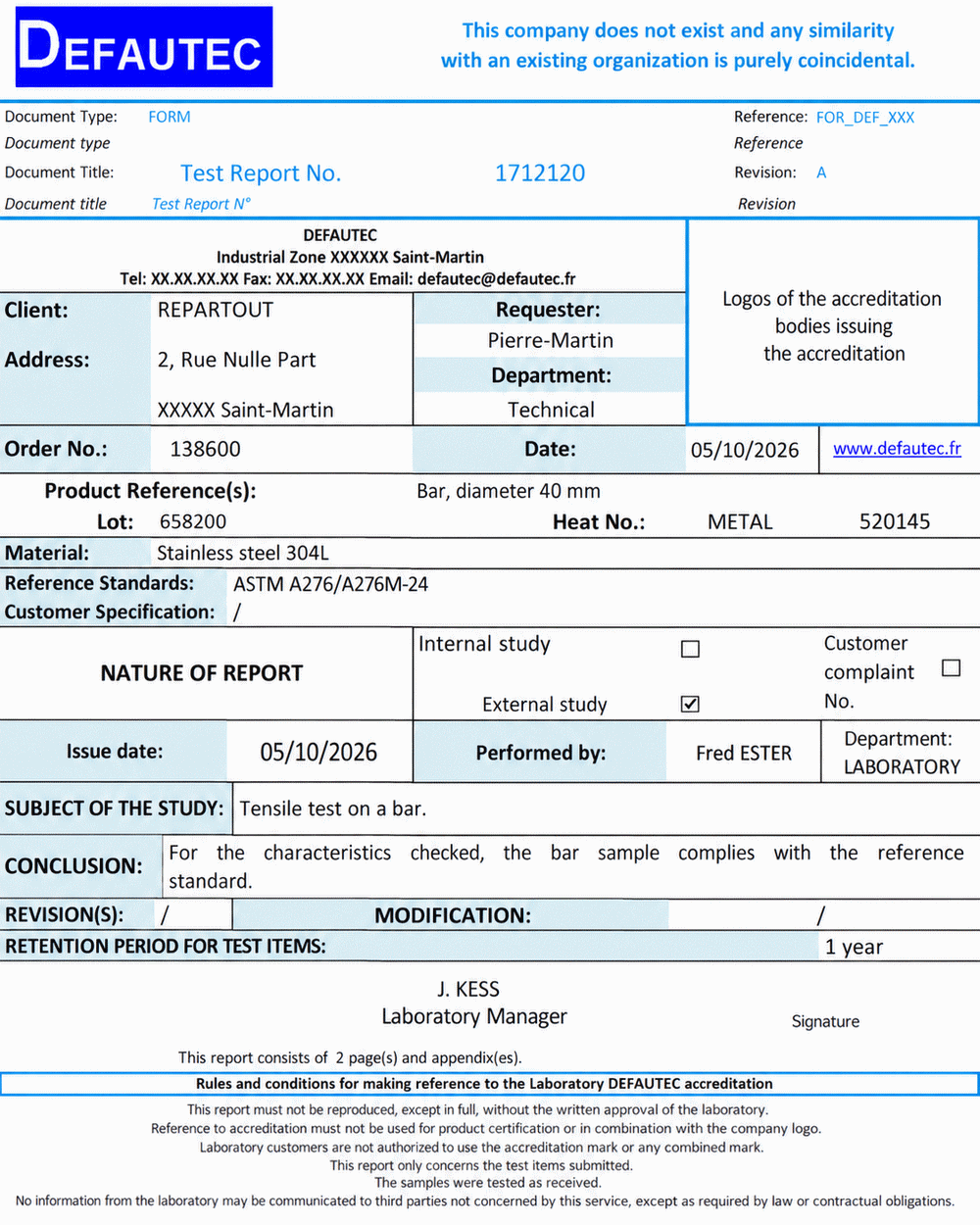
Results are generally communicated in a dedicated test report that must contain all the information needed to interpret and use the results correctly.
For testing performed for internal customers, or under special agreements with external customers, the reporting format may be simplified.
However, all applicable data and information described below must remain available within the laboratory.
The laboratory must include a statement that the report may not be reproduced except in full without the laboratory’s approval.
The report must state that the results relate only to the item tested or calibrated (they do not establish conformity of an entire lot), and that accreditation confirms the laboratory’s competence only for the tests covered by its scope of accreditation.
If the test report includes results of testing performed by subcontractors, those results must be clearly distinguished from results obtained by the laboratory itself.
If you subcontract tests for which your laboratory is accredited, the results must be reported under your responsibility.
If you subcontract tests for which your laboratory is not accredited, the results must be reported under the responsibility of your service provider.
Reports may be issued in hard copy or electronically, provided the requirements of ISO/IEC 17025 are met.
Test-report formats should be standardized wherever practical and adaptable to the types of testing performed, without creating ambiguity or encouraging misuse. They should make the results easier for readers to understand and use.
Reports should be carefully and clearly written.
When sending preliminary results electronically, consider adding a statement such as: “These preliminary results are provided for information only. Only the final report is authoritative.”
When sending a report electronically, make sure it is distributed in a format intended to prevent alteration. Avoid Word documents and use PDF instead. Bear in mind that even protected PDFs can be modified. One approach is to scan documents and provide image-based PDFs, although image files are not inherently tamper-proof.
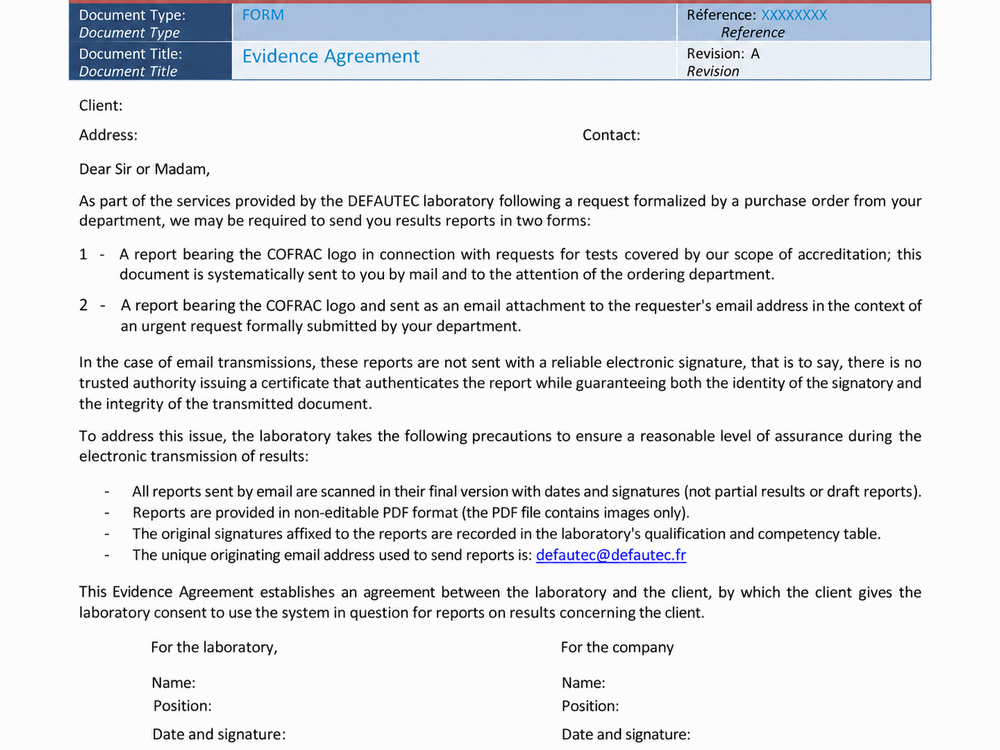
You can also establish an agreement on evidentiary procedures with customers. This formalizes precautions for emailing results and the safeguards customers take to prevent information from being distributed to departments that do not need it.
7.8.2.2 The laboratory shall be responsible for all information provided in a test report or calibration certificate, except when information is supplied by the customer.
When data are supplied by the customer, they must be clearly identified.
A disclaimer must also be included in the report when customer-supplied information may affect the validity of the test or calibration results.
Some tests require input data that the laboratory does not determine and that must therefore be supplied by the customer (for example, a 0.2% proof strength, Rp0.2, needed to determine a fracture-toughness parameter, KIC). A qualification is then necessary because incorrect external data could introduce an error into the result.
When the laboratory was not responsible for sampling (for example, when the sample was provided by the customer), the report must state that the results apply to the sample as received.

As guidance, the report should contain the following information and elements:
– The title (for example, “Test Report”);
– The name and address of the laboratory and the location where testing was performed (if different from the laboratory address);
– A unique report identifier (for example, sequential numbering), identification of each page as part of the report, clear identification of the end of the report, and the issue date;
– The customer’s name and address;
– The accreditation body’s mark if the results are reported under accreditation. The ILAC MRA mark may also be displayed alongside the accreditation body’s mark (the difference in mark sizes must not exceed 5%). Permission to use the original marks must be requested from the accreditation body;
The document ILAC R7, “Rules for the Use of the ILAC MRA Mark,” should be included in your regulatory and standards monitoring activities. ILAC R7 (source document)
Consider adding a statement such as: “Customers are not authorized to use the accreditation mark or the combined ILAC MRA mark.”
– Identification of the test method used: cite the standard for a standardized method, the technique specified by the customer for a customer-prescribed method, or a brief description when it is an in-house method;
For a laboratory with a fixed scope of accreditation, indicate the edition date of the test method applied, even if that edition has since been superseded. Providing this information to the customer is recommended in all cases.
– A description and unambiguous identification of the item tested;
– The date the item was received (if relevant) and the date or period of testing;
– The test results, in a format appropriate to the nature of the test, including units of measurement where applicable;
– Identification of any deviations from, additions to, or exclusions from the standard method;
– The report issue date;
– A reference to sampling procedures used by the laboratory or other parties, where applicable;
– The name, position, and signature (or equivalent identification) of the person authorizing the report;
When necessary to interpret the results, the test report must also include:
– Information on specific test conditions (for example, environmental conditions);
– A statement of conformity or nonconformity with applicable requirements (an option provided by ISO/IEC 17025);
– Opinions and interpretations, where appropriate and required (an option provided by ISO/IEC 17025);
– Where applicable, an estimate of measurement uncertainty associated with the results. This information must be provided when necessary for the validation and use of results, when requested by the customer, or whenever it affects how the results are used;
– Any additional information required in particular sectors.
A disclaimer must also be included when customer-supplied information may affect the validity of the results;
Customer-supplied data must be clearly identified;
– You must inform customers of the rules and conditions governing references to your accreditation.
7.8.3.1 In addition to the requirements listed in 7.8.2, test reports must include the following, where necessary for interpreting the test results:
a) Additions to, deviations from, or omissions from the test method, and information about specific test conditions, such as environmental conditions;
b) Where relevant, a statement of conformity with requirements or specifications (7.8.6);
When issuing a statement of conformity without specific customer requirements concerning measurement uncertainty, remember to add Case No. 2 from LAB REF 02: “Measurement uncertainty associated with the result was not explicitly taken into account when determining conformity or nonconformity with the specification.”
c) Where applicable, the measurement uncertainty, expressed in the same unit as the measurand or as a relative term (for example, a percentage), when:
– it is relevant to the validity or application of the test results;
– the customer's instructions require it, or measurement uncertainty affects conformity with a specification limit.
A product standard often specifies a minimum value for a characteristic, and the conformity assessment body (CAB) determines a result only slightly above this minimum after testing (for example, 451 MPa against a minimum of 450 MPa, with an expanded uncertainty of ±6 MPa; or 4.1% against a minimum of 4.0%, with an expanded uncertainty of ±0.3%). In these cases, the CAB must report the uncertainty even if the customer has not requested it and specify the decision rule used to determine whether the product conforms.
d) Where appropriate, opinions and interpretations (see 7.8.7);
e) Any additional information that may be required by specific methods, authorities, customers, or groups of customers.
7.8.4 Calibration Certificates — Specific Requirements
7.8.4.1 In addition to the requirements in 7.8.2, calibration certificates must include the following:
a) The measurement uncertainty of the measurement result, expressed in the same unit as the measurand or as a relative term (for example, a percentage);
b) The conditions (such as environmental conditions) under which the calibrations were performed and that affect the measurement results;
c) A statement identifying how the measurements are metrologically traceable (see Annex A);
d) The results before and after any adjustment or repair, if available;
e) Where relevant, a statement of conformity with requirements or specifications (see 7.8.6);
f) Where appropriate, opinions and interpretations (see 7.8.7).
7.8.4.2 When the laboratory is responsible for sampling, calibration certificates must meet the requirements listed in 7.8.5 where necessary for interpreting the results.
7.8.4.3 A calibration certificate or calibration label must not contain any recommendation on the calibration interval unless this has been agreed upon with the customer.
This practice was previously not permitted. At the customer's request (which should be formally documented in the purchase order), the service provider may state the date of the next calibration or verification.
7.8.5 Reporting Sampling — Specific Requirements
If the test report includes sampling results, it must also contain:
a) The date of sampling;
b) Unique identification of the item or material sampled (including the manufacturer's name, model or type designation, and serial numbers, as appropriate);
c) The sampling location, including diagrams, sketches, or photographs;
d) A reference to the sampling plan and sampling method;
e) Details of environmental conditions during sampling that affect interpretation of the test results;
f) Information required to evaluate the measurement uncertainty for subsequent testing or calibration.
7.8.6 Reporting Statements of Conformity
7.8.6.1 When a statement of conformity with a specification or standard is provided for testing or calibration, the laboratory must document and apply the decision rule used, taking into account the level of risk (such as false acceptance, false rejection, and statistical assumptions) associated with that decision rule.
7.8.6.2 The laboratory must report the statement of conformity in a way that clearly identifies:
a) The results to which the statement applies;
b) The specifications, standards, or portions thereof that are met or not met;
c) The decision rule applied (unless it is inherent in the requested specification or standard).
The conformity assessment body (CAB) must define the decision rule to be applied by all laboratory personnel. Preferably, it should be based on standards so that there is no ambiguity in the assessment, which may be critical for the product.
When the decision rule is prescribed by the customer, regulations, or normative documents, a more detailed assessment of the level of risk is not necessary.
Readers may also refer to the page: customer/supplier risk.
7.8.7 Reporting Opinions and Interpretations
If a test report includes opinions and interpretations, the laboratory must be able to provide objective evidence supporting them.
Opinions and interpretations must be clearly distinguishable in the test report and must not be construed as product inspection or certification.
When opinions and interpretations are expressed, the laboratory must ensure that only personnel authorized to provide them issue the corresponding statements in reports. Opinions and interpretations may also be provided, where appropriate, for calibration activities.
7.8.7.3 When opinions and interpretations are communicated directly through discussions with the customer, a record of those discussions must be retained.
Opinions and interpretations may address:
– Conformity or nonconformity with applicable requirements;
– Fulfillment of contractual conditions;
– Recommendations for using the results;
– Guidance for improvement.
7.8.8 Amendments to Reports
7.8.8.1 When an issued report needs to be replaced, amended, or reissued, any changes to the information must be clearly identified.
Changes to test reports after issuance may be made only in the form of new documents (such as “Supplement to Report No. …”), which must also meet the requirements described above. The changes must be clearly indicated in the new report.
If an entirely new document must be issued, it must be uniquely identified and include a reference to the original document that it replaces.
When test reports are transmitted by telephone, fax, or email, they must still meet the requirements described above.
Reports created and transmitted electronically must contain the information necessary to identify the issuing organization and the person responsible for authorizing their release.
It is necessary to verify that the transmission was successful, preferably accompanied by sending a documentary copy.
Changes to electronically generated reports must follow appropriate procedures similar to those used for paper documents.
Postal mail remains an option, although it does not necessarily ensure that the intended recipient has received the report, even when sent by registered mail (the company may have received it without the individual responsible for the results having received it), unless confirmation is requested by email.
Conformity assessment bodies (CABs) generally prefer electronic delivery by email. However, it is important to have the requester's individual email address and to ensure that the report is provided in a format that cannot readily be modified (a scanned report, a password-protected PDF—which is not always reliable, depending on the encryption method—or a read-only Excel workbook protected by a macro that is itself protected against viewing, making modification difficult within a short period, etc.).
If you send partial results, clearly state that only the final report is authoritative and that the preliminary results are provided for information only.
Consider establishing evidence agreements with customers to document their agreement with the selected transmission method.
You may also use an accredited provider that can supply a reliable electronic signature (necessarily a more expensive option).